Global venture capital in 2025: A bifurcating market
Headline venture capital investment figures point to an asset class in rude health, but in reality, the picture is more complex. Alter Domus reviews the drivers behind strong investment levels and why some parts of the venture market and performing better than others.
Tim Toska
Group Sector Head, Private Equity
At first glance, the global venture capital market appears to be booming.
Venture capital investment in Q1 2025 climbed to a 10-quarter high of $126.3 billion, rising from $118.7 billion in the previous three months, according to KPMG; some 35 Unicorn assets (start-ups valued at US$1 billion or more) were formed through the quarter, the second highest quarterly total since 2023, according to Pitchbook, and generative AI platform OpenAI landed a record setting US$40 billion funding round at the end of March.
These headline numbers, however, do not tell the full story. Overall venture investment may appear strong, but the asset class has not escaped the fallout from elevated inflation and interest rates, stock market volatility and global trade uncertainty.
Investment value is up, but venture capital deal volume is down. In Q1 2025 only 7,551 deals crossed the line, down from 8,801 deals in the previous quarter and a record quarterly low, according to KPMG.Meanwhile, a Bain & Co analysis shows a 23 percent year-on-year decline in venture capital fundraising, with Pitchbook recording a year-on-year decline in venture capital exit value, which totaled US$322.8 billion in 2024 versus US$331.2 billion in 2023.
A two-tier market
The gap between robust investment activity on the one hand, and falling fundraising and exit value on the other, reflects the emergence of a two-tier venture market that is bifurcating by sector and size.
Perhaps the starkest contrast to emerge is the widening disparity between the red-hot levels of deal activity involving AI-linked companies and start-ups in other sectors.
Indeed, close to a third of total funding round activity in Q1 2025 was generated by the mega OpenAI funding round, with large-language model AI start-up Anthropic another heavyweight contributor to headline numbers, landing a US$4.5 billion funding round raise. Other companies with specific AI-linked capabilities, including KoBold Metals, a developer of AI-powered mining exploration tools, and AI healthcare company Cera, were among the other high-profile performers.
The dominance of AI and machine learning has been such that it accounted for 57.9 percent of combined venture deal value – an all-time record share of the market, according to Pitchbook.
There have been a few other bright spots in the market, most notably in European defense-focused groups, with the Nato Innovation Fund and Dealroom recording a 24 percent rise in investment in European startups focused on developing defense and defense-related technology. Drone maker Tekever and defense software company Helsing have been among the big winners, as European governments and business ramp up defense spending in response to the ongoing Ukraine war.
Investors and dealmakers appear to be doubling down on select segments of the market, upping investment in these areas while putting investment in other areas on hold until macro-economic uncertainty abates. This is one of the main reasons for falling investment volume at time of rising investment value.
Fundraising falters
Macro-economic volatility has also impacted venture capital in a similar way to the buyout space, with volatility making it increasingly difficult to exit portfolio companies at attractive pricing, which then limits the distributions managers are able to make LPs, who in turn have to put the brakes on supporting new fundraising until managers start returning more cash to investors.
This dynamic has shaped what has been a tough fundraising market – which is expected to remain challenging in the near-term as a much anticipated “exit window” is pushed back yet again.
Venture dealmaker had entered 2025 with quite confidence that the year ahead would herald an improving environment for exits, with IPO markets (a crucial exit channel for venture-backed assets) set to reopen as inflation pressures eased and interest rates assumed a downward trajectory.
Escalating trade tension and tariff uncertainty, coupled ongoing conflict in Ukraine and the Middle East, and associated stock market volatility, however, have pushed back any optimism for a wave of exits back to the second half of 2025 at least, or even into 2026.
Venture-backed companies that have test the IPO waters have struggled to land successful listings at stable prices, while other venture portfolio assets that had been gearing up for big-ticket IPOs have delayed their prospective listings due to market uncertainty.
Exiting via funding rounds involving larger venture firms has also been testing, with Pitchbook noting that in the US – the world’s largest venture ecosystem – more than a quarter of funding rounds in Q1 2025 were flat or down rounds (where a start-up raises money at a lower valuation than in previous funding rounds).
There are signs that trade tariff dislocation may be abating, and stock markets have recovered losses from earlier in the year, laying a firmer foundation for potential exits through the second half of 2025. Markets, however, are still choppy, and it will take time for managers to build the necessary comfort to put companies on an exit pathway.
Opportunities ahead… but uncertainty lingers
Through this period of dislocation, opportunities to invest in high-quality, high-growth venture assets will continue to emerge. AI will more than likely continue to dominate deal activity, although defense and cybersecurity startups will also be high on dealmaker target lists.
Other sectors will also present compelling investment opportunity, although in smaller volumes, with cleantech and fintech the sectors outside of AI and defense that dealmakers are keeping an eye on.
Until there is a sense of wide macro-economic stability, however, the bifurcation theme that has shaped the venture investment during the last 12 months will continue to set the tone for market activity through the rest of 2025.
5 operational challenges faced by venture capital firms
Venture capital (VC) is a form of private equity investment financing that involves investing in early-stage startups with high-growth potential. VC firms aim to generate substantial returns for their investors by fostering the growth of these companies and eventually achieving a successful exit, such as through an IPO or acquisition.
However, despite the promising nature of venture capital, firms often encounter a range of operational challenges that can hinder their ability to manage investments effectively and maximize returns.
In this article, we’ll discuss five key challenges that VC firms commonly face and discuss how leading fund administrators like Alter Domus are helping firms overcome them, streamline operations, and stay focused on delivering investor value.
Challenge 1: Managing capital calls and distributions
Venture capital firms will routinely issue capital calls to draw down committed funds from limited partners (LPs). And when they exit portfolio companies, they will issue distributions.
However, both of these processes come with several challenges that can affect fund efficiency, investor satisfaction, and even regulatory compliance.
For example, capital calls require precise timing.Calling capital too early, i.e.,before the VC firm is ready to deploy it, such as before finalizing a deal, can tie up investors’ cash unnecessarily and lead to frustration. Conversely, calling it too late can lead to missed investment opportunities or cash shortfalls.
Additionally, coordinating capital across multiple LPs can be complicated, especially when managing large or global investor bases. There is also the issue of making sure that each investor’s share of the capital call is calculated correctly. This can also be complicated, especially when the firm is managing a mix of different commitments or investment tiers. Miscalculations can cause legal issues or investor dissatisfaction.
In distribution terms, these often depend on successful exits, which are unpredictable. Timing them to meet investor expectations while preserving portfolio value can be difficult. Also, managing distributions often involves complex calculations to ensure each LP receives their correct share of returns.
Distributions also have tax implications, which can vary by investor. For example, U.S. investors may be taxed differently from foreign investors. Managing these tax complexities while ensuring compliance with local and international tax regulations can be a big challenge for VC firms.
Challenge 2. Navigating complex fund structures
As venture capital firms grow and take on more investors, some often set up different types of funds to meet various needs.
For example, they might create co-investment vehicles for large investors, special purpose entities (SPEs) for single deals, or parallel funds to handle different tax or regulatory requirements.
These structures can unlock strategic advantages for VC firms and attract a wider range of investors. However, they also introduce a host of operational, legal, and compliance challenges for venture capital management.
Having multiple entities of fund structures means more data to track, including fund performance, investor allocations, fees, and distributions. Keeping everything accurate across these entities can be difficult.
Different fund structures may also fall under various regulatory regimes. Keeping up with ongoing filings, disclosures, and audits across jurisdictions can be costly and error-prone.
In the same vein, different fund structures often come with varying tax implications, especially when dealing with cross-border investments. Managing these complexities and ensuring tax efficiency for both the firm and its investors can be a daunting task. Inaccurate tax reporting or inefficient structuring can lead to unexpected liabilities or penalties.
Furthermore, explaining the structure, rights, fees, and returns across different vehicles to LPs can be challenging. Complex structures can obscure performance and increase LP concerns about transparency and alignment of interests.
Challenge 3: Meeting an expanding regulatory environment
As the venture capital and private fund industry, in general, matures, governments and regulatory bodies across the world are ramping up their oversight, creating new compliance burdens that funds must follow.
This expanding regulatory environment poses significant challenges for VC firms.
Complex global regulations:
Many VC firms often execute deals and raise capital from LPs in multiple countries, each with its own set of regulatory frameworks. Adhering to diverse national and international regulations, such as securities laws, tax codes, and anti-money laundering measures, can be cumbersome and time-consuming.
Regulations are continually evolving. A regulatory framework that is compliant today may no longer be so tomorrow. This requires firms to be proactive in monitoring changes and adjusting their strategies accordingly.
Rising compliance and operational costs:
Meeting regulatory demands can be expensive. Firms must invest in compliance teams, legal counsel, and technology systems. These rising costs can strain smaller firms and divert capital away from growth-oriented activities.
Constraints on strategic flexibility:
Regulatory considerations, including ESG-related requirements, may limit the types of investments firms can pursue or slow down decision-making as additional due diligence becomes necessary.
Data privacy and cybersecurity pressures:
Regulations like GDPR impose strict obligations on how personal and financial data is handled. VC firms must ensure strong data protection protocols are in place or risk fines and reputational damage.
Legal liabilities:
With stricter regulatory oversight, VC firms face an increased risk of legal action for non-compliance, which could include monetary fines and penalties.
For example, the SEC reported it had filed a total of 583 enforcement actions against firms in 2024 and secured a record-breaking $8.2 billion in financial penalties, the highest total in its history. Legal action against a firm can lead to reputational damage, which in turn can affect a firm’s ability to attract future investors or raise additional funds.
Challenge 4: Delivering accurate and timely LP reporting
Modern LPs, armed with greater knowledge and a more discerning approach to their investments, are demanding a richer and more frequent flow of information from venture capital management.
However, delivering on these expectations is not without its challenges for VC firms. Here are some hurdles companies currently face.
Complexity of data collection and aggregation:
VC firms often invest in multiple startups, each with its financial systems, performance metrics, and stages of development. Aggregating data from these diverse sources, including equity positions, valuations, fund expenses, and portfolio performance, can be time-consuming and prone to errors.
Valuation challenges:
One of the most significant challenges in VC reporting is valuing early-stage investments accurately. Unlike public companies, which have easily accessible market prices, early-stage startups often lack clear market comparables, making valuations more subjective.
These valuations are typically determined through methods like discounted cash flow (DCF) or using comparable company analysis, both of which can be influenced by assumptions that may not be universally agreed upon.
This subjectivity introduces potential discrepancies between what different LPs consider the “true” value of the portfolio. Furthermore, the valuation of startups can fluctuate dramatically based on the latest funding rounds, exits, or market conditions, making it difficult to provide consistent and reliable valuation data in a timely manner.
Custom reporting requirements:
LPs often have unique reporting requirements based on their investment strategies, risk profiles, and other preferences. Meeting these customized reporting needs while maintaining accuracy and consistency can be challenging, particularly for smaller VC firms with limited resources.
Internal resource constraints:
Many VC firms, especially smaller ones, lack the resources or dedicated staff to manage the heavy workload required for accurate LP reporting. This can lead to overburdened teams, delays, and errors in reporting, which can negatively impact investor confidence.
Manual processes and lack of automation:
Many VC firms still rely on manual processes for collecting, organizing, and analyzing investment data. This increases the risk of errors and delays and makes it challenging to produce accurate and timely reports.
Challenge 5: Scaling operational infrastructure and talent
As venture capital firms grow, success brings a new set of operational demands.
Early-stage VC firms can often function effectively with lean teams, informal processes, and minimal infrastructure. But as they raise larger funds, expand their portfolios, and attract more established LPs, this becomes unsustainable. Firms must scale their operation infrastructure and talent to support this expansion and growth.
But again, many firms experience challenges in this area.
For example, as the firm grows, it needs to hire specialized professionals across various functions, including deal sourcing, legal, operations, and portfolio management. The demand for skilled individuals in these areas is high, and with many firms competing for the same talent, recruitment becomes costly and time-consuming. Finding candidates who not only have the necessary skills but also align with the firm’s culture is a big challenge.
Once the right talent is acquired, retaining it can also be an issue. Failing to build a clear career progression path, offer competitive compensation, or provide sufficient work-life balance can lead to high turnover, which disrupts operations and increases recruitment costs.
Operationally, scaling infrastructure often means higher costs. As the firm’s portfolio and the number of deals increase, so do the demands for more sophisticated systems and tools. Firms must invest in technology and support to handle portfolio management, investor relations, and reporting. These tools can require significant upfront costs for software, licensing, and implementation, and ongoing maintenance expenses.
For many VC firms, outsourcing some of these operational tasks to specialized service providers can be a good practical solution, as we’ll see in the next section.
How outsourced venture capital services address these challenges
To overcome some of the challenges outlined above and streamline their operations, many VC firms are turning to outsourced VC service providers like Alter Domus.
These firms offer the expertise, technology, and dedicated resources needed to manage critical back-office functions that would otherwise consume significant time and effort if handled internally.
For instance, these providers offer advanced fund administration platforms and experienced teams capable of managing every stage of capital calls and distributions. They can handle everything from calculating individual LP obligations to processing payments and providing detailed transaction reporting.
To address the increasing demands of regulatory compliance, these providers often have dedicated compliance teams that stay current with evolving rules. They can assist with developing and implementing compliance programs and managing regulatory filings, thus helping firms stay compliant.
Outsourced service providers can also help VC firms improve the quality, consistency, and transparency of their reporting. These providers typically bring a combination of experienced professionals and purpose-built technology platforms that streamline the reporting process and ensure greater accuracy.
For example, they offer technology and resources to centralize financial and operational data across funds, integrating information from multiple systems into a single, unified platform. This approach reduces the need for manual data entry, minimizing errors and ensuring that all financial information is accurate and up-to-date.
Many service providers offer secure, user-friendly online portals where VC firms and stakeholders can easily access real-time reports, transaction histories, and performance data. This centralized access enhances transparency, allowing firms to share information quickly and efficiently with investors, auditors, and other key parties.
Finally, outsourcing offers a flexible and cost-effective solution for scaling operational infrastructure and talent. Firms gain access to a scalable pool of specialized professionals and technology platforms without the fixed costs and management overhead of building an in-house team.
Wrapping: Venture capital operational challenges
Venture capital firms face a range of operational challenges as they grow and manage increasingly complex portfolios. These challenges as seen include managing capital calls and distributions, meeting expanding regulatory compliance requirements, delivering accurate and timely LP reporting, finally and scaling operational infrastructure and talent.
However, these operational complexities don’t have to hinder growth and success. By strategically partnering with specialized service providers, venture capital firms can access the infrastructure, technology, and expertise needed to tackle these challenges effectively.
Additionally, outsourcing frees up VC firms to focus on what really drives value, which is identifying, investing in, and nurturing high-potential, innovative companies.
How fund administration supports scaling-up venture capital operations
Every venture capital firm aspires to grow with time, whether that means raising larger funds, managing a broader portfolio, or expanding into new markets. However, growth often comes with increased operational complexity.
As the firm expands, managing critical tasks like capital calls and distributions, investor reporting, compliance, and governance in-house can start straining internal resources and divert attention from core fund priorities like sourcing deals and providing strategic support to portfolio companies.
In light of this, many VC firms are increasingly turning to professional fund administration services. These services provide the expertise, systems and infrastructure that VC firms need to scale effectively, without sacrificing operational efficiency or affecting the ability to meet their obligations to investors and regulatory authorities.
In this guide, we’ll dive deeper into the role of fund administrators in helping VC firms scale, including the key functions these entities provide.
Challenges of scaling up venture capital operations
Before we get into how fund administration can enable more efficient scaling, let’s first look at three major operational challenges that many venture capital firms face as they expand their operations.
Increased fund complexity
Scaling a venture capital operation usually includes either launching more funds, managing larger funds, or structuring funds in increasingly complex ways. All these changes add operational strain to the firm.
Increased number of funds: Managing multiple funds, each with its own investment focus, lifecycle, and mandate, creates a higher administrative burden. More funds require more resources to ensure each operates smoothly and in line with its objectives.
Larger funds: Bigger funds demand more disciplined capital deployment, enhanced reporting, and a stronger internal team to manage investor relations.
Complex fund structures: Specialized funds, such as region-specific funds, co-investment vehicles, and special purpose entities (SPEs), introduce additional layers of governance, reporting, and compliance obligations.
Regulatory burdens increase
Growth venture capital firms also tend to increase their exposure to regulatory scrutiny. For example, crossing certain AUM thresholds can trigger mandatory filings with relevant regulators like the SEC. Additionally, more investors mean more Know Your Customer (KYC) and Anti-Money Laundering (AML) compliance work.
International expansion adds additional complexity to regulatory requirements. Firms must follow varying regulations, such as tax codes, disclosure rules, and securities laws, in each jurisdiction where they operate. Staying on top of all regulatory obligations can be quite challenging.
Growing LP demands for transparency
Limited Partners (LPs) are increasingly expecting greater transparency and more comprehensive reporting from General Partners (GPs) in the private equity industry. They wantmore frequent, detailed, and transparent reporting, not just during fundraising rounds, but throughout the fund lifecycle. This includes timely capital account statements, NAV updates, performance metrics, and ESG disclosures.
Meeting these heightened expectations for an increased number of investors and funds can be challenging without the proper mechanisms and support in place.
The good news for VC firms is that these challenges are manageable. One of the most effective solutions is leveraging professional fund administration services.
What is venture capital fund administration?
Venture capital fund administration involves outsourcing back-office tasks to a specialized third-party firm. Essentially, the third-party, known as a fund administrator, takes over the day-to-day operational or administrative tasks, such as fund accounting, investor reporting, and regulatory compliance, that VC firms would otherwise need to manage in-house.
How fund administration helps scale venture capital firms
Fund administration plays a crucial role in supporting firms during periods of expansion by managing the increasing demands of back-office functions. For example, they can provide support in several key areas, including the following.
Streamlining capital call and distribution processes
Fund administration automates and organizes the capital call and distribution workflow, ensuring that these transactions are executed seamlessly and on time. This reduces the manual workload on VC firms, mitigates the risk of errors and improves the overall experience for investors.
Enhancing LP reporting and transparency
Fund administration provides the necessary infrastructure to ensure that all limited partners (LPs) receive timely, accurate, and consistent reports on their investments. Such transparency fosters trust and confidence among investors and helps maintain strong, ongoing relationships as the firm scales its operations.
Supporting regulatory compliance and governance
Fund administrators ensure that VC firms meet all regulatory obligations as they scale by managing the necessary filings and documentation. They handle KYC and AML checks and maintain proper records on these. In addition, fund administrators closely monitor changes in the regulatory environment and advise firms on any changes they might need to make to ensure compliance.
Why outsourcing fund administration makes strategic sense
According to a 2024 Ocorian survey, 99% of private equity, venture capital, and real estate fund managers globally plan to increase outsourcing over the next three years, with nearly half (46%) targeting a 25–50% increase in outsourced functions.
Besides helping firms overcome some of the operational complexities that come with scaling, outsourcing fund administrations offers several other significant advantages.
Cost savings
Building an in-house fund administration team requires significant resources, including hiring specialized staff, investing in technology, and training employees to keep up with changing regulations. As a firm grows, the costs associated with maintaining this infrastructure can quickly add up.
Outsourcing to a third-party fund administrator like Alter Domus, allows VC firms to leverage professional services and technology without the overhead of managing these functions internally.
Access to specialized expertise and evolving best practices
Outsourcing gives VC firms access to professionals who are highly experienced in private fund structures and up to date with the latest regulations, best practices, and financial technologies. This ensures higher accuracy and professionalism across key fund activities, including accounting and investor reporting.
Freeing internal teams to focus on core investing activities
Perhaps one of the most significant benefits of outsourcing fund administration is that it frees internal teams toprioritize sourcing, evaluating, and managing investments.
By offloading the time-consuming and often complex administrative tasks deal teams can dedicate their expertise and energy to identifying promising investment opportunities and actively supporting their portfolio companies. This ensures that the core value-creation activities of the VC firm remain the central focus.
Alter Domus: A partner in venture capital fund administration
If you’re looking for a fund administration partner that offers deep industry expertise, great flexibility, and tailored solutions to support your growth, Alter Domus could be a good fit.
Here’s what you can expect when you partner with Alter Domus:
Comprehensive fund accounting:
Expert management of fund accounting, including investment tracking, valuations, waterfall and carried interest calculations, and much more.
Investor reporting:
Detailed and transparent reporting to keep your investors informed about the performance and health of their investments and the fund in general..
Capital call and distribution processing:
Streamlined management of capital calls and distributions to ensure accuracy and timely execution.
Regulatory compliance support:
Comprehensive guidance on meeting regulatory requirements and maintaining compliance across different jurisdictions.
Tech-driven solutions:
Integration of advanced fund administration solutions designed to automate workflows, enhance operational efficiency, and provide real-time transparency.
Full fund lifecycle management:
End-to-end support, from fund formation through to exit, with tailored services to ensure smooth operation at all stages.
Audit support:
Comprehensive audit assistance, including the preparation of relevant documentation and coordination with auditors to ensure a smooth audit process.
Wrapping up: How venture capital fund administration supports growth
Fund administration plays a key role in the growth of venture capital firms by providing the structure and expertise needed to manage increasing operational demands and complexity. It takes care of administrative tasks like fund accounting, investor reporting, and compliance management, which frees internal teams to focus on what matters most: identifying high-potential investments and driving growth.
With deep industry knowledge and a commitment to excellence, Alter Domus is the ideal venture capital fund administration partner to help streamline operations and support your firm’s growth. Explore Alter Domus venture capital solutions and fund administration solutions to learn more.
Fund accounting & reporting services for venture capital firms
Venture capital accounting is a niche field of accounting that focuses on managing, tracking, and reporting the financial operations of venture capital (VC) funds.
Unlike traditional business accounting, which is primarily concerned with the revenue, expense, and profits of a company, venture capital accounting involves more complex financial structures and tasks, such as tracking capital contributions, calculating investment valuations, and managing the distribution of returns.
In this guide, we will explore the essential components of venture capital accounting and explain some of the benefits of outsourcing this critical function to specialized fund accounting services providers like Alter Domus.
The unique fund accounting needs of venture capital firms
Venture capital (VC) firms operate in a dynamic and highly specialized environment within the private markets space. As a result, their fund accounting needs are markedly different from those of investment managers with public market strategies.
Below are some accounting functions and needs unique to venture capital firms:
Capital calls and distributions management:
Managing and documenting capital calls to limited partners (LPs) and distributions from the fund, and ensuring proper allocation based on ownership and allocation ratios.
Portfolio company valuation:
Performing periodic valuation of portfolio companies according to industry standards.
Carried interest and waterfall calculations:
Tracking carried interest (carry) and modelling complex waterfall structures to determine profit allocations among stakeholders.
Net asset value (NAV) calculation:
Determining the fund’s NAV, which represents the total value of the fund’s assets minus its liabilities.
Fee management:
alculating and tracking management fees, performance fees, and reimbursements at both fund and investor levels.
Investor reporting:
Providing timely, transparent, and customized reports to limited partners.
Why timely and transparent financial reporting matters for VC firms
Because venture funds typically operate with long timelines and limited liquidity, LPs depend on clear and regular reporting to understand how their capital is being deployed and managed. This includes updates on valuations, capital movements, and overall fund performance.
As such, the ability to deliver accurate and timely information can be a major strategic advantage for VC firms, offering the following benefits:
Increased trust and credibility with LPs:
Timely and transparent reporting fosters trust by showing that the firm is actively monitoring the financial health of its portfolio and making informed decisions. When investors can see accurate and up-to-date financial data, they are more likely to stay engaged and confident in the firm’s ability to manage their money.
Better reputation in the market:
Firms that consistently provide accurate, transparent financial reporting are often viewed more favorably in the market. A track record of transparent reporting serves as a signal of professionalism and operational maturity. This reputation can help attract new investors, high-quality investments, talented portfolio companies, and top-tier talent. All this can contribute to long-term success.
Regulatory compliance and risk mitigation:
VC firms are subject to regulatory requirements that demand accurate financial disclosures. Transparent reporting ensures compliance with these regulations, avoiding legal complications and potential penalties from bodies like the Securities and Exchange Commission (SEC).
Benefits of outsourcing fund accounting and reporting for VC firms
According to a Dynamo Software survey, one of the biggest challenges facing venture capital and private equity funds today is financial reporting, with 64% reporting delays in preparing financial reports. This is not exactly surprising as venture capital fund accounting can be quite complex and demanding.
Indeed, this is one of the primary reasons many VC firms today are choosing to outsource this crucial function to specialized fund accounting services providers like Alter Domus.
Outsourcing venture capital fund accounting and reporting offers several advantages, including the following:
Access to expertise and best practices:
Fund accounting is a specialized discipline that requires deep knowledge of financial regulations, valuation methodologies, and industry-specific reporting standards. Outsourcing gives VC firms access to professionals who are highly experienced in private fund structures and who are up-to-date with the latest regulatory changes and best practices. This ensures a higher level of accuracy and professionalism in all financial reporting.
Improved compliance and risk management:
Regulatory scrutiny of VC firms has increased, making it more important than ever to ensure accurate, timely, and compliant financial reporting. Fund accounting service providers use standardized processes and dedicated controls that reduce the likelihood of errors and help meet fiduciary and regulatory obligations. This helps VC firms avoid costly mistakes and reputational damage.
Cost savings and efficiency:
Outsourcing venture capital fund accounting helps firms reduce the overhead costs associated with maintaining an in-house accounting team. Hiring, training, and retaining skilled professionals can be expensive, especially when the workload fluctuates. Third-party service providers offer scalable solutions, allowing firms to pay for exactly what they need when they need it.
Faster, more consistent reporting:
Experienced third-party providers typically leverage purpose-built technologies and automation tools to deliver consistent, timely reporting. As previously mentioned, better reporting improves investor trust and confidence and can increase a VC firm’s overall reputation and perception in the market.
Freedom to focus on core investment activities:
Outsourcing fund accounting and reporting frees up internal resources to focus on high-value activities likebuilding relationships with investors, sourcing new deals, and optimizing the performance of their portfolio companies.
How Alter Domus supports fund accounting and reporting for venture capital firms
Alter Domus is a global fund administrator with deep expertise in alternative assets such as venture capital funds. The company helps VC firms better manage their accounting and reporting needs with a range of practical and reliable services that include:
Capital call and distribution processing:
Managing the process of capital calls and distributions of proceeds.
Accurate calculation and processing of management fees and carried interest in line with fund agreements.
Financial statement preparation:
Preparing financial statements in accordance with relevant accounting standards (e.g., IFRS, US GAAP).
Tax compliance support:
Assisting in preparing tax documentation and ensuring compliance with relevant regulations.
Investor Reporting:
Generating customized reports for investors that provide clarity on fund performance, portfolio holdings, and financial activities.
Wrapping up: Fund accounting & reporting for venture capital firms
Venture capital accounting is vastly different from traditional accounting. It includes unique tasks such as tracking capital calls, conducting fair value assessments, calculating carried interest, and managing complex portfolio valuations. These tasks require specialized knowledge and systems to ensure accuracy, compliance, and timely reporting.
As such, many VC firms are turning to expert fund administrators to handle these specialized accounting tasks. Alter Domus is one such provider, offering accounting and reporting services built around the specific needs of venture capital funds. Learn more about Alter Domus’ venture capital solutions and fund administration services, or get in touch to discuss how we can help with your fund’s accounting and reporting requirements.
Venture capital funds are pooled investment vehicles that provide financing to startups and emerging companies with high growth potential. In exchange, they take an ownership stake and aim to generate significant returns by exiting these investments later on through events like initial public offerings (IPOs), mergers, or acquisitions.
Like all participants in the financial markets, venture capital funds are subject to a range of regulations designed to ensure transparency, protect investors, and maintain market integrity.
For VC managers, understanding and adhering to these regulations is crucial not only to avoid legal repercussions and penalties, but also to build investor trust, manage risks effectively, and secure the long-term success of both the fund and its portfolio companies.
This article explores the key compliance requirements that apply to venture capital firms, the challenges of managing compliance internally, and how fund administrators like Alter Domus can support VC firms in meeting their obligations.
Key compliance obligations for VC firms
Let’s look at some of the key compliance requirements for starting and managing a venture capital firm or fund.
SEC registration and reporting
Most venture capital funds in the US are typically “private funds,” which means they don’t need to register with the Securities and Exchange Commission (SEC) as ‘investment companies”..
However, VC firms are still subject to certain obligations. This includes completing specific sections of Form ADV Part 1A, such as information about their business, ownership, and any sanctions they or their personnel have faced.
In addition, VC firms that qualify as ERAs are required to regularly update their Form ADV to ensure the SEC has accurate and timely information. This includes 2 key obligations.
ERAs must file an update to Form ADV at least once annually, within 90 days of the end of their fiscal year.
In addition to the annual filing, firms must promptly amend Form ADV whenever there are material changes to the information previously disclosed, such as changes or updates in ownership, business structure, or disciplinary history.
Fundraising and marketing
Most VC firms raise capital from investors through “exempt offerings,” which essentially allows them to sell securities without registering with the SEC.The most commonly used exemption is Regulation D, particularly Rule 506(b) and Rule 506(c).
Rule 506(b) allows VC firms to raise an unlimited amount of money from accredited investors and up to 35 non-accredited investors. However, this rule forbids general solicitation, meaning that firms cannot publicly advertise their offerings or use broad marketing tactics. All fundraising efforts must be done privately, typically through existing relationships or direct outreach.
Rule 506(c) offers a different approach by permitting general solicitation and public advertising, opening up the possibility of reaching a wider pool of potential investors. However, this flexibility comes with a significant condition: all purchasers of the fund’s interests must be accredited investors, and the venture capital fund must undertake reasonable measures to confirm each investor’s accredited status.
Regardless of whether a venture capital fund uses Rule 506(b) or 506(c), a critical compliance requirement under Regulation D is the timely filing of Form D with the SEC. This brief notice, which provides basic details about the offering, including the amount being raised and the type of investors targeted, must be submitted within 15 days after the first sale of securities.
In addition to the aforementioned SEC regulations, venture capital funds must also be mindful of state-level securities laws, often referred to as “blue sky laws,” in each state where they solicit investors. These state regulations may impose additional requirements that firms must meet alongside the federal rules of Regulation D.
It’s crucial to consult legal counsel to ensure compliance with state requirements.
Anti-Money Laundering (AML) and Know Your Customer (KYC) Requirements
Previously, many venture capital firms, particularly those that qualified as ERAs, were not required to follow comprehensive Anti-Money Laundering (AML) regulations in the same way as banks or broker-dealers under the Bank Secrecy Act (BSA).
While the SEC could take enforcement actions related to misleading statements about voluntary AML procedures, there was no direct mandate under the BSA for these VC firms to establish full-fledged AML programs.
However, a significant regulatory shift is on the horizon with a final rule issued by the Financial Crimes Enforcement Network (FinCEN) on August 28, 2024.
This new rule amends the BSA regulations to include certain SEC-registered investment advisers (RIAs) and ERAs within the definition of “financial institution” under the BSA. This means that a significant portion of venture capital fund managers will now be directly subject to AML obligations.
Specifically, from January 1, 2026, VC firms must establish formal AML compliance programs that include procedures for identifying and reporting suspicious activities, conducting risk assessments, and maintaining thorough records. Additionally, firms must implement Know Your Customer (KYC) protocols to verify the identity of their investors and assess the source of their funds.
Environmental, social, and governance (ESG) considerations
Although Environmental, Social, and Governance (ESG) reporting isn’t yet a formal compliance requirement for many venture capital firms, it has rapidly become a significant area of focus for both regulators and investors.
In regions like the EU, regulations such as the Sustainable Finance Disclosure Regulation (SFDR) are already pushing firms to disclose how they integrate ESG factors. Though these regulations are currently more applicable to larger firms, they signal a shift that may expand to all VC firms over time.
In the U.S., the SEC has adopted rules for public companies to disclose climate-related risks. Similar frameworks could eventually extend to private funds, including venture capital firms.
What’s more, LPs are increasingly demanding greater ESG data reporting from firms, with some even willing to pay more for it. For example, according to a report by PwC Luxembourg, two-thirds of surveyed LPs indicated a willingness to pay higher management fees if it leads to significant improvements in ESG data reporting by their GPs.
Additionally, nearly 45% of respondents said they would consider a fee increase of 5% to 9% if it resulted in more comprehensive and higher-quality ESG reporting practices.
Proactively adopting ESG policies and reporting frameworks can prepare VCs for future regulatory changes and at the same time help gain a competitive edge in the market by demonstrating to investors that they are forward-thinking, transparent, and responsible in their approach to managing investments.
Strategic importance of compliance
Builds trust and credibility:
A strong compliance record signals to investors and portfolio companies that the VC firm operates ethically and with integrity. This fosters trust and enhances the firm’s reputation, which is crucial for attracting and retaining both investors and promising startups.
Prevents legal and financial penalties:
Non-compliance can lead to significant fines, legal battles, and even the loss of licenses to operate. A sturdy compliance program minimizes these risks.
Protects against financial crime:
Implementing strong KYC and AML procedures, as mandated by regulations, safeguards the firm and its investors from financial crimes and reputational damage.
Challenges of managing compliance internally
High resource demands:
Effectively managing compliance internally demands significant time and personnel. For smaller venture capital firms, this can stretch resources thin and lead to oversight gaps where certain regulatory requirements are missed or misunderstood.
Constantly changing regulations:
The regulatory environment for venture capital is complex and frequently shifting, with new rules, reporting standards, and jurisdictional requirements. Keeping pace with these changes internally is difficult, especially for firms operating across multiple regions. This increases the likelihood of inadvertent noncompliance.
Insufficient internal expertise:
Compliance requires deep knowledge of specialized areas, such as financial regulations, anti-money laundering policies, and evolving trends like ESG disclosures. Many firms, particularly smaller ones, lack professionals with expertise in these areas. This lack of sufficient in-house expertise could lead to misinterpretations of regulatory requirements and thus non-compliance.
Rising operational costs:
Maintaining compliance internally can be expensive. Firms may need to invest in additional staff, ongoing training, continuous monitoring, and internal audits. For smaller firms, these added costs can divert resources away from other important business activities, such as deal sourcing and portfolio management.
How Alter Domus supports venture capital compliance
Alter Domus provides specialized compliance services that help venture capital firms meet regulatory requirements effortlessly. Key areas of support include:
Regulatory filings:
Assistance with the preparation and submission of crucial filings such as Form ADV, Form D, and other jurisdictional reporting obligations.
Ongoing monitoring and support:
Continuous monitoring of regulatory changes and updates relevant to VC firms, proactive communication of these changes, and ongoing support in adapting compliance programs accordingly.
AML and KYC support:
Assistance with creating, implementing, and maintaining KYC and AML programs.
ESG reporting support:
Assistance with ESG data collection, aligning with relevant ESG frameworks, and preparing ESG disclosures to meet the expectations of limited partners and comply with any relevant regulations.
Audit support:
Assistance with audit preparation, including organizing required documents, coordinating with auditors, and addressing audit-related questions or issues.
Final thoughts: Venture capital compliance requirements
Compliance management is a critical function in venture capital firms. Besides helping firms meet legal requirements, it builds investor trusts, reduces risk exposure, and contributes to long-term operational stability.
However, for firms with lean teams, staying on top of compliance can be time-consuming and complex. This is where specialized support, like that provided by a fund administrator like Alter Domus, can make a big difference.
Alter Domus takes care of your compliance requirements and operations, including regulatory filings, AML/KYC implementation, and ESG reporting, so you and your team can focus on your core business of finding and nurturing high-potential startups without having to worry about meeting your regulatory obligations.
Portfolio optimization and the Alter Domus Score: A use case for CLOs
Why the Alter Domus Scores’ simplicity, robustness, and capacity for automation makes it an effective metric for trade optimization.
Rudolph Bunja
Head of Portfolio Credit Risk
Overview
Alter Domus recently introduced the Alter Domus Score (ADS), a metric for fixed income assets that managers can use to improve their portfolio trade optimization decisions. The ADS is unit-based and can be applied universally across all types of fixed income assets, allowing managers to rank order assets based on relative value. The ADS is useful for managers when considering portfolio allocation tradeoffs where constraints exist. These constraints can be market, investor, or regulatory based.
In this paper, collateralized loan obligations (CLOs) are referenced as a use case to demonstrate how a CLO manager can apply the ADS framework to help optimize portfolio allocations. An example of ADS portfolio optimization in a typical environment for CLO managers is presented. The objective of the CLO manager in this case is to maximize the overall portfolio ADS while adhering to various constraints.
The examples first cover the case for a single CLO portfolio and then expand to a scenario in which a CLO manager seeks to optimize its portfolio allocations across multiple CLO portfolios. The goal is to provide an overview of the practical applications of the ADS framework.
Portfolio optimization and ADS: a use case for CLOs
A typical US-based CLO portfolio includes primarily first-lien senior secured loans to corporate borrowers. These portfolios are managed actively, with trading adhering to reinvestment criteria outlined in the CLO’s indenture. The lifecycle of a CLO usually includes a ramp-up period, a reinvestment period, and an amortization period.
The reinvestment criteria establish the rules within which the asset manager can trade. In addition to defining the types of assets that can be purchased (such as eligible collateral obligations), these criteria generally include various categories of portfolio-level constraints [1]:
Portfolio concentration limitations,
Collateral quality tests, and
Coverage tests.
To enhance the efficiency and productivity of investable capital while adhering to reinvestment criteria, managers carefully navigate various trade-offs in portfolio allocation decisions. By adopting a trade optimization approach, managers effectively refine their investment choices so that they strike the right balance between risk and return. This strategic method not only maximizes capital utilization but also aligns with the overarching investment goals.
A CLO manager has a range of metrics to optimize, such as yield, portfolio par, or average life. In this context, we previously outlined the benefits of utilizing ADS as a foundation for potentially enhancing optimization or generating trade ideas. The ADS, unlike other metrics, offers a parsimonious, objective, and easy-to-use measure that is ideal for trade optimization.
It is important to recognize that, beyond the general reinvestment criteria outlined in the CLO indenture, managers are faced with additional key external constraints dictated by market conditions – specifically, the array of investments available for purchase as well as prevailing market prices. Consequently, fundamental questions arise, such as determining the universe of eligible assets available for acquisition and their corresponding prices. Furthermore, it is necessary to consider whether asset substitutions within the existing portfolio could lead to a more optimal solution. This consideration applies to prospective assets in both the primary and secondary loan markets. Incorporating robust trade optimization methods and tools, alongside the manager’s credit and trading expertise, enhances the manager’s ability to balance a portfolio’s risk-return profile while adhering to constraints.
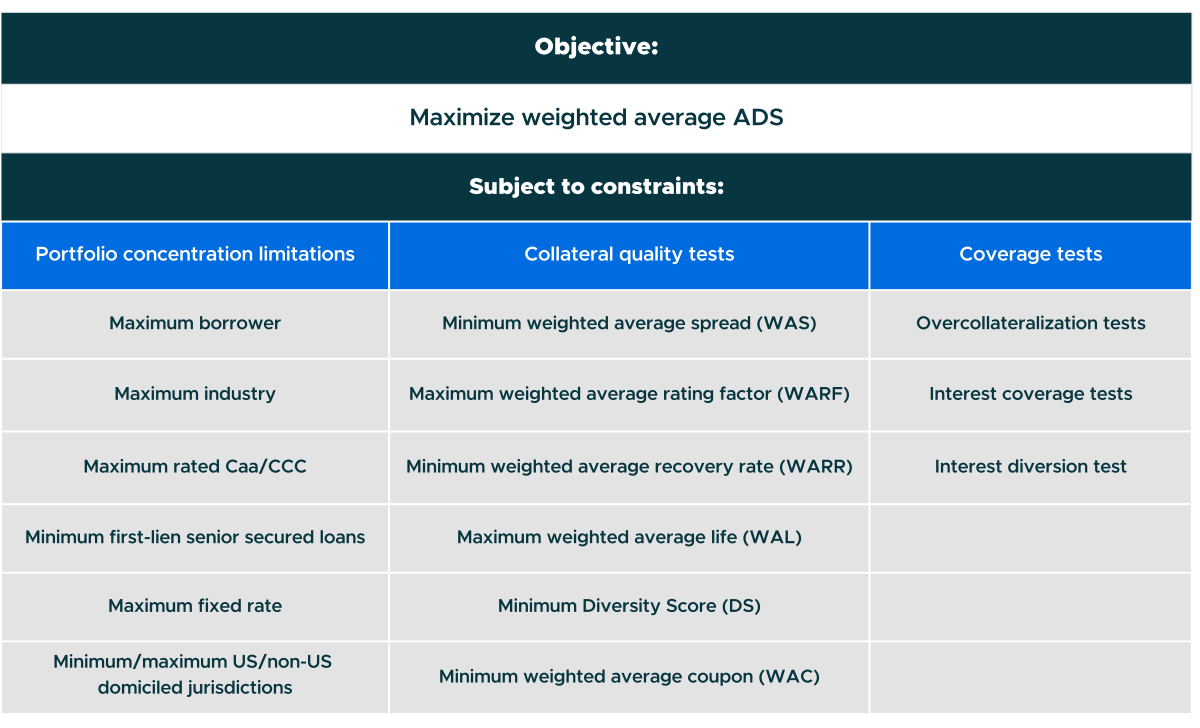
Exhibit 1 outlines the primary objective of maximizing the overall weighted average ADS, in accordance with the constraints generally specified by a CLO indenture. The exhibit includes examples of typical constraints applicable to a CLO, assuming that any asset under consideration meets the eligibility criteria for purchase. In other words, the goal is to find the optimal asset weights in a portfolio that will maximize ADS while adhering to specified constraints [2].
Exhibit 1: ADS optimization objective for a typical CLO portfolio
In theory, there could be multiple optimal solutions due to various possible portfolio compositions that could meet all constraints, though in practice this is a remote possibility. Typically, some flexibility remains within certain constraints given the available assets and considering a CLO manager’s discretion. In many CLOs, specific tests can often be adjusted, allowing room for one test (like recovery rate) to impact (or modify) the WARF or WAS test. This ultimately leads to finding a more optimal solution, assuming the manager determines that the tradeoff is justified.
Portfolio allocations across CLOs
The optimization objective described above pertains to a single CLO portfolio. However, CLO managers often oversee multiple CLOs simultaneously as they are repeat issuers. The complexity increases as these CLOs may have been issued under different market conditions over time. Additionally, there could be some differences in the constraints applicable to each CLO. Other examples include varying experiences in ratings migration within the portfolio, and some CLOs may be at different stages in their lifecycle, such as during reinvestment or amortization periods. These factors contribute to the complexity of constraints.
In the simplest scenario, the ADS can be optimized independently for each CLO, assuming there are no constraints on the availability of assets to be purchased or traded. In this case, the proportion of allocation to each individual asset is chosen optimally to provide the maximum marginal increase to the ADS for each CLO portfolio. Therefore, it is possible for the optimal portfolio allocation of any prospective asset to range from 0% to 100% for any given CLO.
However, it is not straightforward in practice. The following scenarios are examples that point out potential constraints that may limit an optimal solution across CLO portfolios:
Limited availability – the CLO manager may encounter a limited supply of certain assets within the marketplace.
Legal/compliance requirements – the CLO manager may be subject to internal directives imposed by legal and compliance guidelines, which govern asset allocations across the manager’s CLOs.
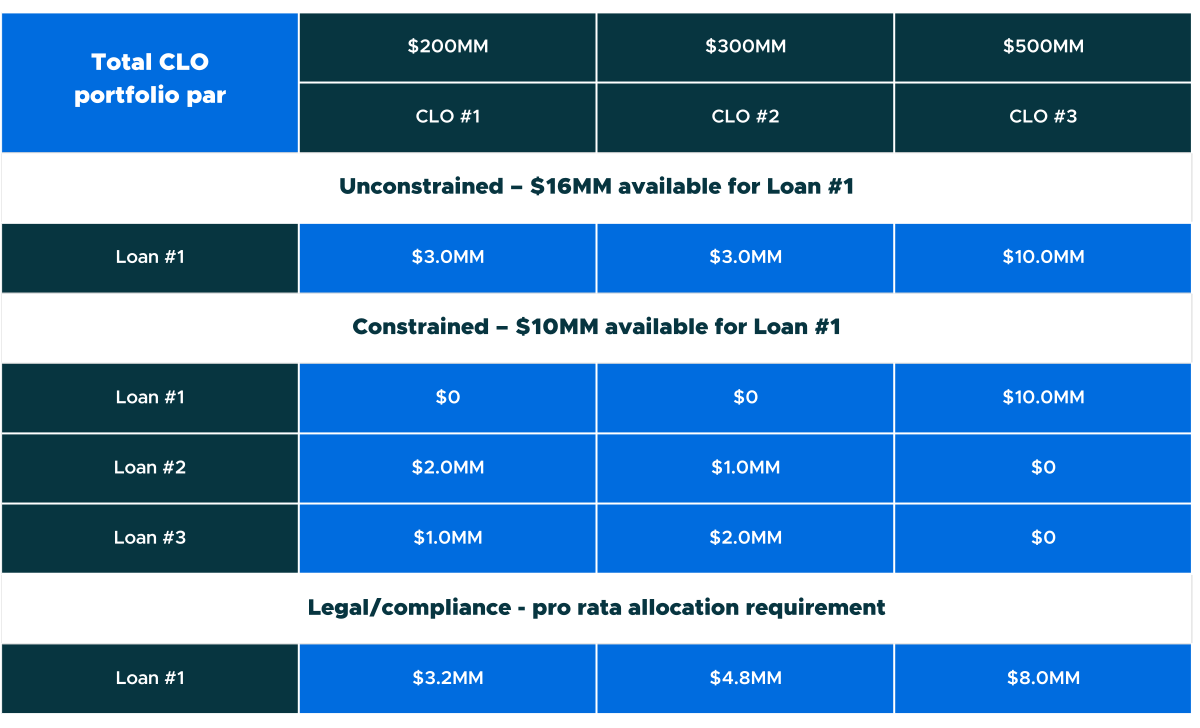
Exhibit 2: Potential portfolio allocations to a loan under various scenarios
Exhibit 2 above provides an example of a manager looking to reinvest cash proceeds with potential allocations for a particular loan, Loan #1, across three CLOs. The optimal allocation suggests that a total of $16MM should be distributed across the CLOs as shown in the unconstrained scenario. This assumes that the optimal solution is based on the maximization objective described earlier, where the analysis is subject to each individual CLO’s constraints.
If the manager determines that only $10MM of Loan #1 is available, the optimal solution (assuming the greatest marginal benefit is realized by CLO #3) then suggests a different allocation accordingly as shown in the constrained scenario. The analysis also suggests that the remaining $6MM of cash proceeds should be invested in two additional loans, Loan #2 and Loan #3, with respective allocations.
In instances where there is a strict legal or compliance requirement for proportional distribution of the asset, the process is straightforward. Although internal guidelines may recommend a specific portfolio allocation for an individual investment, various factors related to any CLO could prevent this. These factors include potential breaches of certain portfolio constraints, such as limits on borrower, industry, or rating concentrations.
It is understood that these additional limitations result in a suboptimal solution compared to the theoretical unconstrained case – essentially, we could say that this solution is the ‘optimal practical’ solution.
This example suggests that an iterative process would likely occur in practice to find an optimal practical solution, especially if the analysis is conducted on a pro forma basis or after the manager learns what is ultimately available in the marketplace, potentially even with changes in market prices.
To conclude
Fixed income managers often consider tradeoffs when making investment decisions to efficiently deploy investable capital. Alter Domus has introduced the ADS as a basis for managers to enhance their portfolio trade optimization decisions based on one objective and sound metric that is applicable across all fixed income investments. The ADS can be particularly useful in helping managers achieve the best relative value for their investments while facing constraints.
CLOs have been presented as a use case to demonstrate how a CLO manager can apply the ADS framework to optimize portfolio allocations. The example described earlier illustrated ADS portfolio optimization in an environment typical for CLO managers. The objective of the CLO manager is to maximize the overall portfolio ADS while adhering to various constraints as outlined in a CLO indenture. While managers can use other variables such as yield or portfolio par to optimize their portfolio, it has been demonstrated that using the ADS as an alternative metric can be beneficial since it incorporates into one measure the major variables considered in trading credit instruments.
The ADS serves as an effective metric for trade optimization, thanks to its simplicity, robustness, and capacity for automation. Its straightforward nature allows for easy interpretation, while its consistency supports investment decision-making across different market conditions for fixed income investments. Additionally, the automation aspect streamlines the optimization process, making it a valuable tool for enhancing trading strategies.
For AD clients, including clients of Solvas and Enterprise Credit & Risk Analytics, the ADS is offered as an additional measure to support our clients with their trade optimization, portfolio allocation, and risk analytics.
Please contact [email protected] for further information on how to access the ADS.
[1] The reinvestment criteria often involve more detailed requirements than mentioned here. These include par maintenance conditions, variations in criteria based on different trading classifications (such as credit risk/improved, defaulted or discretionary), and can vary depending on the CLO’s lifecycle stage. Additionally, the criteria can differ across CLOs with trading conditions that may be agreed upon between parties before the CLO’s inception, such as deep discount conditions, excess Caa/CCC haircut conditions, or amend to extend guidelines.
[2] Alter Domus utilizes a mixed integer linear programming platform to find the optimal solution for these situations. This method of optimization is well-documented in scientific literature.
Private markets pioneers: The rise of interval funds
As private markets managers adopt new fund structures in order to attract non-institutional capital and provide institutional with additional flexibility, interval funds are emerging as a structure of choice for many.
In the fourth of a five-part series, Alter Domus reviews the rapid growth of interval fund assets under management (AUM), the reasons for the structure’s popularity, and the operational and investment capability managers require to run interval funds successfully.
At a time when closing a traditional, ten-year private markets fund has been challenging, managers raising capital through interval funds have seen assets under management (AUM) accelerate.
In the US alone, interval fund AUM has almost quadrupled during the last five years, increasing from just US$18.6 billion in January 2020 to US$93.4 billion in January 2025, according to Morningstar figures reported byPitchbook.
Interval AUM has surged during a period when private markets fundraising has been in decline. Year-on-year fundraising has now fallen for three consecutive years and in 2024 was down 30 percent on the five-year average, according to Bain & Co analysis.
The growth in interval fund assets has provided a timely capital boost for the alternative assets industry at a difficult point in the fundraising cycle.
Breaking down barriers
Interval funds have been available to investors as early as the 1990s but have experienced a surge in popularity during the last five years as managers have moved to broaden investor bases and raise more capital from non-institutional channels.
The non-institutional investor market has been difficult for private markets managers to crack, with the investment minimums and long periods of illiquidity associated with the traditional, 10-year, close-ended private markets fund an awkward fit for individuals and family investors who have smaller amounts to invest and require more flexibility than long-term horizon institutional investors. A 2024 survey of 100 financial advisers by consultancy NextWealth found that illiquidity was one of the biggest barriers to individual investors investing in private markets.
The huge opportunity that the democratization of private markets presents, however, is so vast (Bain & Co forecasts suggest that non-institutional allocations to alternatives could climb as high as US$12 trillion by 2034) that managers are now working harder than ever to improve their reach into the non-institutional market, and interval funds have emerged as one of the most popular ways of doing so.
Interval funds, however, are not exclusively the preserve of non-institutional investors, with managers offering interval fund investing opportunities noticing strong appetite from institutional clients too.
Ten-year funds are generally a good fit for institutions investing over the long-term, but the flexibility of the interval fund has appealed to LPs too, who like the having the option of adjusting private markets exposure without having to go into the secondaries market, as well as the immediate exposure to private markets assets that interval funds provide.
In ten-year funds, LPs make commitments at the start of the fund’s life, but that capital is only put to work as it is called down through the duration of the fund’s distribution. Uncalled capital can’t be deployed in other assets, as LPs have to be able to meet all capital calls by the fund manager when required. In an interval fund capital is put to work straightway and fully invested in a portfolio of assets at the next trading date
The more liquid structure of an interval fund, meanwhile, has been particularly attractive as distributions from 10-year funds in LP portfolios have dried up. Interval funds have given institutional and non-institutional investors the option of drawing regular yield from their investment but also retain long-term exposure to private markets assets.
A flexible option
Interval funds have emerged as an attractive channel of non-institutional investment as the structure offers opportunities for investors to take liquidity at set times (either quarterly or monthly) as well as allowing investors to invest on daily basis, in the same way as they would in a mutual fund, rather than having to wait for a manager to come to market with a new fund every five years.
It is important for investors to understand, however, the interval funds are not liquid in the same way as stocks or mutual funds, where you can take liquidity on daily basis. Interval funds only offer the option to take redemptions during pre-agreed windows, and these redemptions will typically be limited at around five percent of the interval fund’s net asset value (NAV) at the time of redemption.
But while interval funds are not designed to be traded or present daily liquidity, they do give investors, particularly non-institutional investors, the comfort that their capital is not entirely locked up should they need cash in case of emergencies or life events such as divorce or illness.
The right rails
For managers managing, or seeking to manage, interval funds, it is essential to have the right operational rails in place to manage interval vehicles effectively. The infrastructure that GPs use to raise and manage 10-year funds is different to what is required to oversee interval funds.
Interval funds demand a capable back-office that can operate scale to meet the compliance, reporting and portfolio construction aspects of running these vehicles.
Managers have to have the bandwidth to support potentially hundreds of non—institutional investors in an interval fund, as opposed to relatively small group of institutional LPs in a 10-year fund, and understand the specific compliance, know-your-client (KYC), anti-money laundering (AML) and tax rules as they apply to non-institutional clients.
Managers also have to ensure that their back-offices are able to cope with the additional reporting and portfolio modelling requirements of interval funds. Publishing quarterly or monthly NAV figures to facilitate redemption windows, and the associated reporting, will be step up for managers new to the interval fund market.
Portfolio modelling is also more complex, with managers leaning on real time data from the back and mid-office to calculate what portion of a fund should be held in liquidity sleeves, and what cash will be generated by the portfolio naturally, in order to cover upcoming redemption requests.
Indeed, interval fund portfolios will be structured to include mix private markets assets, such as secondaries and private credit, to ensure that there is always some cash flowing back into the fund. Calculating liquidity requirements and modelling the ideal portfolio construction demands a large and sophisticated back-office function.
The staffing and technology costs that come with handling these obligations are significant and will involve large sums of capital expenditure.
Working with an experienced, tech-enabled fund administration partner, that has the scale and digital infrastructure to absorb the reporting and data demands that come with running interval funds, offers a cost-effective option for managers moving into the interval funds space.
Taking advantage of the large upswing in interval fund AUM, and the opportunity the structure provides to penetrate the non-institutional investor base will not only require front-office investment management pedigree, but also a resilient and robust back-office capability.
Private markets pioneers: a natural evolution – the growth of evergreen funds
Despite a slowdown in private markets fundraising, capital flows into evergreen fund structures are on the up
In the second of a five-part series, Alter Domus explores the reasons behind forecasts for double-digit growth in evergreen assets under management (AUM), and why institutional investors in particular are funneling more capital into evergreen fund structures.
Despite double-digit declines in annual private markets fundraising, the outlook for investment in evergreen fund structures is bright.
Evergreen funds (open-ended funds that do not have a fixed fund life, allowing investors to enter or exit at their discretion) have been around for decades, but have seen a surge in popularity during the last five years as investors have recognized the flexible liquidity and immediate market exposure they offer for alternative assets portfolios.
The momentum behind evergreen interest has been particularly strong during the last 24 months as fundraising for traditional, close-ended 10-years funds has cooled off and private markets managers and investors have sought alternative routes for securing and allocating capital.
The growing focus across private markets on raising more funding from the non-institutional investors has been a further spur for growth in evergreen fund assets under management (AUM), as evergreens provide family offices and individual investors with the opportunities to build exposure to private markets strategies at lower investment minimums (starting at $25,000 versus the typical $5 million minimum for a 10-year, close-ended fund) and periodic opportunities to take liquidity.
A natural evolution
The rise and rise of evergreen fund structures is a natural evolution for a private markets asset class that has ambitions to expand its investor base beyond its institutional core.
According to Hamilton Lane, evergreen funds currently account for just 5 percent of overall private markets AUM, which represents close to US$700 billion. Ten years on from now, however, Hamilton Lane anticipates that evergreens will account for at least 20 percent of total private markets AUM, with growth in allocations from high-net worth individual investors the key driver of the rise, as evergreen fund AUM growth outstrips that of 10-year funds.
Forecast growth for evergreen AUM, however, will not be driven exclusively by non-institutional channels, with Hamilton Lane expecting institutional investors to also increase their investment in evergreen structures as a tool for fine-tuning and managing private assets portfolios.
The liquidity optionality offered by evergreen funds has become particularly attractive for institutions during the last 24 months as interest rate dislocation has made it difficult for managers to exit portfolio assets at attractive valuations, leading to a slowdown in distributions back to investors. According to Bain & Co, distributions as a portion of net asset value (NAV) fell to just 11 percent in 2024 – the lowest rate in more than a decade.
Investors have had the option of taking liquidity through LP-led and GP-led secondaries deals but have often had to bear a discount to NAV when doing so. The opportunity that evergreen funds provide to offer some liquidity on a monthly or quarterly basis, at NAV, has appealed to institutions.
Long-term appeal
The appeal of evergreen structures, however, hasn’t only been supported by short-term, cyclical liquidity concerns.
Both institutional and non-institutional investors have also been attracted to other features of evergreen funds, perhaps most notably the time in the market that evergreens can offer.
In traditional 10-year funds large sums of capital have to be committed upfront, but as these funds are blind pool investment vehicles, those commitments are not put to work in assets on day one, but drawn down and invested over the investment period of the fund – usually five years.
Evergreen funds, however, will already be comprised of a core portfolio of assets, that investors will be fully invested as soon as they invest in the fund, providing much more scope to benefit from compounding returns.
Enabling investors to be fully invested from day one has a significant positive impact on the returns an evergreen structure is able to produce.
An analysis of the annualized returns generated by 13 equity-focused evergreen funds from Q3 2019 to Q3 2024 by Hamilton Lane found that evergreens outperformed both the MSCI Word Stock Market Index and all of private equity.
Hamilton Lane illustrates that an evergreen fund that generates a steady (but not spectacular) 12 per cent return over ten years will provide investors with a 2.5 times multiple on invested capital inside a decade. Only six percent of close-ended funds deliver the same money multiple, and have to produce IRRs of more than 20 percent to do so. Capital allocated to evergreen funds and fully invested on day one generates strong comparative money multiples without having to produce knockout returns.
Fee benefits
Fee and carry costs for evergreen funds also compare favorably to those of close-ended funds.
Management fees for the two types of fund structure come out roughly the same for the two structures after a 10-year period, according to Hamilton Lane, with closed-ended fund fees higher earlier in the fund life as capital is deployed during the investment period, and tapering off towards the end of the fund’s life, while evergreen fund management are spread out evenly through a ten-year period.
When factoring in carried interest costs, however, overall fund costs for evergreen funds come in lower than close-ended funds, with evergreen carry charged at around 15 percent and closed-ended fund carry holding at around 20 percent.
As more evergreen funds launch and competition for investor capital intensifies, fees for evergreen funds could come down further, particularly as more price-conscious individual investors invest growing sums in private markets evergreens.
A fund structure for the future
The closed-ended fund structure will remain an important pathway for capital deployment, but will not be the only route to private markets exposure in the future as non-institutional investors account for an ever-greater share of the investor base and institutional investors take advantage of the flexibility that evergreen funds offer for accessing liquidity and managing portfolios.
The uptick in evergreen fund launches is only just beginning.
Learn more about Alter Domus’ fund administration services
Alter Domus has significantly expanded its capabilities to support the administration of open-ended private market funds, including evergreen structures. This development aligns with the growing demand from institutional and retail investors for greater liquidity and flexibility in alternative investments.
Alter Domus has enhanced its open-ended fund administration by enabling more frequent NAV calculations and streamlined liquidity management, allowing fund managers to better meet investor redemption and subscription needs. Leveraging the Temenos Multifonds platform, the firm automates essential processes such as capital calls, valuations, and distributions, while integrating with financial networks like SWIFT and NSCC to improve settlement efficiency. It also offers comprehensive transfer agency services—acting directly in Luxembourg and partnering with providers in North America and the UK to manage diverse distribution channels. Additionally, Alter Domus has strengthened its investor reporting and regulatory compliance capabilities, including support for evolving frameworks like ELTIF 2.0.
The expansion of Alter Domus’ services reflects a broader industry trend toward the democratization of private markets. Regulatory changes in the EU, US, and UK are broadening access to private market investments, leading to increased demand for fund structures that offer liquidity and flexibility. Alter Domus’ enhanced capabilities position it to meet these evolving needs, supporting both traditional institutional clients and a growing base of retail investors. By leveraging advanced technology and comprehensive services, Alter Domus enables fund managers to efficiently administer open-ended and evergreen fund structures, aligning with the industry’s shift toward more accessible and flexible investment vehicles.
Services
Open-ended Fund Administration
While they offer significant opportunities, OEF characteristics also come with enhanced commitments. Marry these with the nuances of alternative asset classes and you need experts to unlock the opportunity.
Private debt financing vs bank lenders: How the market is evolving
Explore how private debt financing is evolving and competing with traditional bank lenders.
Corporate lending was once the exclusive domain of commercial banks. However, over the last one and a half decades, a combination of economic shifts, market disruptions, regulatory reforms, and a growing hunger among investors for higher yields have catalyzed the rise of an alternative form of corporate funding known as private debt, or private credit.
Today, private debt is one of the most important components of the global business financing space.
This article looks at the growing influence of private debt financing and how it stacks up against traditional bank lending. We’ll look at why businesses are increasingly turning to it, the benefit it offers to both borrowers and lenders, and the strategies that banks are employing to stay competitive as private debt increasingly challenges their market dominance.
What is private debt financing?
Private debt financing refers to loans or credit extended to businesses by lenders who operate outside the traditional banking system. These are collectively known as non-bank lenders, and include private debt funds, asset management firms, and business development companies.
The returns for these non-bank lenders and their investors come primarily from interest payments on the loans they issue. These loans typically carry higher interest rates than traditional bank loans or publicly traded bonds. The higher rate reflects the added risks lenders take on, including the fact that private loans are typically illiquid (they can’t be easily sold or traded), and that borrowers are often small to mid-sized companies that may have less predictable cash flow or weaker credit profiles
The rise of private debt financing: A short history
Although private debt has existed in various forms for decades, its role in the financial ecosystem significantly expanded following the 2008 financial crisis.
As banks grappled with heightened regulatory scrutiny and capital constraints in the aftermath of the crisis, many scaled back their corporate lending activities. This created a vacuum in the market, particularly for middle-market companies, which were now deemed too risky for banks to lend to.
Recognizing this void, non-bank lenders quickly moved in to fill the gap, offering more flexible, accessible financing solutions to businesses that would have otherwise struggled to secure funding.
Since then, private debt as an asset class has grown a lot. Currently, the global private debt market is valued at over $1.8 trillion (from just over $300 billion in 2010), with Preqin estimating it will reach $2.64 trillion by 2029.
The continued appetite and demand for private credit is driven by its appeal to businesses looking for financing alternatives to bank loans, and hunger among investors for yields that outpace traditional fixed-income investments.
Comparing private debt financing and bank lending
Let’s look at the primary differences between private debt.
Source of capital
As mentioned, lenders such as private debt funds and asset management firms that operate outside the traditional banking system issue private debt. These entities typically raise capital from institutional investors (such as pension funds, insurance companies, endowments, family offices, and high-net-worth individuals) with the specific mandate to grow it through investments like private debt. Since private lenders are not deposit-taking institutions, they are not subject to the same regulatory requirements as banks.
Traditional bank financing, by contrast, comes from regulated financial institutions, such as commercial banks and credit unions. These lenders use funds from customer deposits to issue loans and, as such, are subject to strict financial regulations that greatly shape how they assess credit risk and limit the types of loans they can issue.
Loan structure and flexibility
Private debt offers greater flexibility in structuring loans. Terms such as repayment schedules, covenants, interest types, and amortization are negotiated directly between the borrower and lender and thus can be tailored to their specific needs, circumstances, and preferences.
In contrast, traditional bank loans follow more standardized terms. Because banks must follow regulatory requirements and internal risk guidelines, the loan products they offer tend to be more rigid. Borrowers must meet predefined credit criteria, and there is usually less room for customization of the loan terms and structure.
Type of borrowers served
Private credit tends to serve riskier borrowers, or those who have more complex or unique financial needs, such as mid-market companies, private equity-backed firms, or those in high-growth sectors. These borrowers often struggle to meet the stringent requirements of traditional banks, particularly when it comes to having an established credit history or meeting certain size, cashflow or profitability thresholds.
In contrast, traditional banks generally serve larger, well-established companies with strong credit ratings, consistent financials, and a stable operating history.
Price of capital
The price of capital for private debt is generally higher than traditional bank financing. Private lenders charge higher interest rates and fees to offset the increased risk they are taking on, as mentioned earlier.
The price of capital from traditional banks is typically lower due to their lower risk exposure and regulated status.
Benefits of private debt financing
For borrowers
Access to capital: Private debt provides an alternative for businesses that may not qualify for traditional bank loans. And for those who can still qualify for commercial bank loans, it allows them to diversify their sources of capital and reduce reliance on banks.
Flexibility in terms: Private debt allows for customized loan structures, as we have seen, including repayment schedules, interest rates, and covenants. This flexibility helps businesses better align financing with their unique needs and cash flow situations.
Speed and efficiency: Private debt deals can be processed faster than traditional bank financing (due to fewer regulations). This can give companies faster access to capital when time is critical.
For lenders
Attractive returns: Private debt typically offers higher yields than other traditional fixed-income investments like public market bonds, making it an attractive option for lenders seeking superior returns on capital.
Diversification and low correlation to public markets: Private debt allows funds and asset managers to diversify their portfolios beyond just traditional equity or public credit. Since private debt is not publicly traded, its performance is typically less correlated to public market fluctuations. Therefore, it can provide stability during periods of market downturns.
Control and customization: The flexibility of private credit enables lenders to structure deals that better align with their desired outcomes and risk tolerance.
How banks are competing with private debt lenders
As private debt financing continues to gain traction, traditional banks are stepping up their game. Rather than ceding ground to non-bank lenders, banks are evolving their strategies to remain competitive and better serve the shifting needs of borrowers.
Prioritizing efficiency and speed
To match the agility of private debt firms, banks are focusing on improving the efficiency and speed of their lending processes. While regulatory frameworks limit how much banks can alter their lending models, they are finding ways to accelerate deal timelines and enhance borrower experiences. Many are streamlining approval processes, offering faster credit decisions, and creating more responsive loan servicing models.
A key driver behind these improvements is technology. For example, banks are increasingly leveraging AI and machine learning to assess credit risk more accurately and automate key parts of the underwriting workflow, resulting in quicker and more efficient loan approvals.
Developing in-house private credit capabilities
Recognizing the strong demand for private credit, major banks are building their own private lending operations. Big banks like Goldman Sachs, Morgan Stanley, and JPMorgan Chase all offer a private debt practice. These internal platforms allow banks to directly participate in the high-growth private debt space, while leveraging their existing client relationships and financial infrastructure.
Partnering with private debt firms
Rather than going head-to-head with private credit lenders, some banks are choosing to partner or collaborate with them. By forming co-lending partnerships with private debt lenders, banks can pool resources and expertise to offer larger, more flexible financing solutions. These partnerships enable banks to maintain a foothold in the private debt market without needing to create their own private credit offerings from scratch.
Final thoughts: Private debt financing vs bank lenders
The corporate lending landscape has evolved significantly since the 2008 financial crisis, with private debt becoming a key alternative to traditional bank loans. Offering flexibility, speed, and tailored solutions – including asset based loans – this form of debt funding has become increasingly attractive, particularly to businesses with unique financing needs or that don’t meet the criteria of traditional banks.
Meanwhile, for fund and asset managers, private credit offers an opportunity to deliver significantly higher yields than what is possible with other fixed-income instruments. For a broader perspective on how this asset class compares to its public market counterpart, explore our article on private credit vs. public credit.
As a leading provider of private debt solutions, Alter Domus offers the operational infrastructure and support fund and asset managers need to execute and manage private debt strategies with efficiency and ease.
Visit our Private Debt Solutions page to learn more about how Alter Domus can help you better capitalize on the growth of private debt financing and achieve your goals.
Analysis
Private credit vs. public credit: Understanding the key differences and benefits
Understand the difference between private and public credit, including the benefits of each option.
Private credit and public credit represent two distinct segments of the global credit market. While both serve the same fundamental purpose, which is to provide capital to borrowers while generating consistent returns for investors, they differ significantly in structure, accessibility, and their risk and return profile.
In this private credit vs public credit comparison guide, we’ll break down how the two asset classes stack up against one another so investors and borrowers alike can decide which is the better option for their needs and circumstances.
Understanding private and public credit
What is private credit?
Private credit refers to corporate lending that takes place outside the traditional banking system and public markets. It occurs between private investors and companies that prefer not to issue debt publicly. Non-bank lenders such as private debt funds, asset management firms, and business development companies (BDCs) often provide this type of credit.
Private credit is most commonly used by SMEs or middle-market firms that may have problems securing commercial bank loans due to their size, credit profile, or complex business models. Transactions are typically negotiated privately and often feature customized terms tailored to the specific needs of both the lender and the borrower.
As an asset class, private credit has gained popularity in recent years, particularly among middle-market companies looking for customized financing solutions and investors seeking higher yields than what’s currently being offered by bank loans and public debt, fueling the rapid expansion of the private debt market.
What is public credit?
Public credit refers to debt instruments, such as corporate bonds, that are issued and traded on public markets.
Larger, more established companies seeking capital from a wide pool of investors generally offer these instruments. Public credit is subject to extensive regulatory oversight, and details such as interest rates and maturity dates are publicly disclosed and accessible through open markets.
Private credit vs public credit: Key differences
Let’s look at some key differences between private and public credit.
Investor access
Public credit is available to both institutional and retail investors through platforms like bond markets or mutual funds. In contrast, private credit is generally limited to institutional investors such as private debt funds, mainly due to high minimum investment thresholds and the fact that there’s no open market for this asset class..
Standardization vs customization
Public debt instruments are typically standardized. This standardization allows for efficient trading and widespread accessibility. However, it also limits the ability to tailor loan terms to the specific needs of individual borrowers.
Private credit, on the other hand, offers greater customization. Loans can be structured to meet borrowers’ unique requirements, including flexible repayment schedules. For instance, a growing company seeking financing for a specific project might require a loan with a unique repayment structure that aligns with its projected cash flows. Private credit lenders can accommodate such needs.
Transparency and regulation
Public credit is highly regulated. Issuers are required to disclose financials, credit ratings, and material updates on a regular basis, which translates to high transparency for investors.
Private credit operates in a more opaque environment. Detailed financial information may not be publicly accessible, and valuation may rely on third-party assessments. This lack of transparency increases the complexity of analyzing and monitoring private credit investments.
Liquidity
Public credit boasts high liquidity, meaning it’s relatively easy for investors to exit their investments. Private credit, on the other hand, is highly illiquid. There’s limited secondary market activity for the latter, and investors must be ready to commit their capital for multiple years (typically 5-10 years).
Risk and return profile
Private credit tends to carry higher risks than its public counterpart. This is primarily due to lower liquidity in private credit instruments. Additionally, private credit deals often involve smaller, less-established companies, which can increase the potential for default. To compensate for these increased risks, private credit typically offers higher yields.
Conversely, the yields of public credit are lower due to its higher liquidity and the fact that it generally involves lending to larger, more established firms, which have a lower risk of default.
Benefits of private credit
Private credit offers several benefits for both investors and borrowers.
Investors
For investors, the biggest benefit of private credit is the potential for enhanced returns. As mentioned, this asset class offers higher yields to compensate for its illiquidity and the overall higher risk of investments. For example, while investment-grade corporate bonds may yield 3–6%, private credit strategies (such as direct lending or mezzanine financing) often deliver 8–12% or more in annual returns. The Cliffwater Direct Lending Index (CDLI), for example, returned 12.13% in 2023 and has delivered a 9.55% annualized total return since its inception in 2004.
The other benefit is diversification. Private credit allows investors and managers to diversify their portfolios beyond just traditional equity or public debt. It has low correlation to public markets and can therefore act as a hedge against market volatility.
Finally, private credit allows investors to negotiate and tailor debt arrangements to align with their specific risk and return objectives.
Borrowers
Private credit provides a crucial source of capital for borrowers who may face challenges securing financing from traditional sources like banks. In particular, private debt financingenables businesses to structure deals quickly and confidentially, often on terms that align more closely with their unique operational and financial needs.
Private debt deals can also be completed faster, which is especially valuable in time-sensitive situations. Furthermore, unlike public debt, which requires detailed disclosures, private debt transactions are typically confidential. This allows borrowers to avoid disclosing sensitive information, which could impact their competitive position or market perception.
Benefits of public credit
Just like private credit, private credit also has its benefits for both investors and creditors.
Investors
Since public credit instruments, like corporate and government bonds, can be traded easily in secondary markets, this allows for quicker investor portfolio adjustments in response to changing market conditions or investment objectives.
Additionally, public disclosure requirements associated with public credit instruments make it easier to assess the relative value and potential worthiness of an investment.
Borrowers
For borrowers, public credit markets enable businesses to raise large amounts of capital efficiently from a broad investor base. Additionally, successfully issuing and managing public credit can enhance a borrower’s credibility, visibility, and creditworthiness in the eyes of stakeholders. The transparency and oversight involved can signal to the market that the company is financially sound and can meet its obligations.
Finally, for investment-grade issuers, the cost of capital in public markets is typically lower than private debt due to the lower perceived risk from public scrutiny and the liquidity offered to investors.
Final thoughts: Choosing between private credit and public credit
Private and public credit play important roles in the debt financing ecosystem. But as seen, they offer quite different value propositions for both investors and borrowers. Private credit stands out for its flexibility and potential for higher returns. It appeals to long-term investors willing to accept illiquidity and higher risk for the chance of greater rewards.
On the other hand, public credit offers greater liquidity, accessibility and a lower-risk profile. It is a better fit for investors who prioritize ease of entry and exit, transparency, and standardized terms.
Ultimately, choosing between private and public credit comes down to your investment objectives, risk appetite, and time horizon. By understanding what each option brings to the table, you can make more informed decisions and build a well-balanced credit strategy. Many sophisticated investors choose to incorporate both into their portfolios to balance risk and maximize returns.
For fund or asset managers looking to unlock the full potential of private credit, Alter Domus offers specialized solutions that support every stage of the private credit lifecycle, from fund structuring and loan administration to data analytics and investor reporting.