
Blog
Private markets firms are scaling faster than their operating models. A new approach to operating intelligence is becoming essential to support better decisions, stronger governance, and long-term growth.

Charlotte Hogg
Chief Executive Officer
March 5, 2025

In my recent whitepaper on the Operating Intelligence – A New Opportunity for Investors, I explored a structural challenge emerging across private markets: as firms scale, their data, governance and operational infrastructure often fail to scale with them.
That paper focused on the nature of the issue — the limits of legacy operating models.
But stepping back as CEO, I believe the implications run deeper still. The problem is not simply operational inefficiency. It is becoming a strategic fault line.
So here is a broader perspective on what operating intelligence now means for leadership, resilience and competitive differentiation in the next phase of private markets.
Over the past decade, the industry has matured at extraordinary speed. Firms have expanded across strategies, geographies and products. LP expectations have risen. Regulatory scrutiny has increased. And the pace of decision-making has accelerated.
Yet behind the performance, many operating models still look remarkably familiar.
For too long, the operational layer of private markets has been treated as a necessary function. Something to manage. Something to outsource. Something to keep running in the background.
This paradigm is coming to an end. As private markets scale, operating models are no longer a back-office concern. They are becoming a strategic advantage.
Private markets have always been complex. Cross-border structures. Multiple entities. Different reporting requirements. Unique fund terms. Asset-level nuance.
What has changed is the scale at which that complexity now operates.
Many firms are running more funds, across more strategies, with more portfolio companies and more investors than ever before. They are expected to deliver faster reporting, deeper transparency, and stronger governance.
And they are doing this while operating in a world where data is everywhere, but insight is not.
The result is simple: private markets firms are being asked to make faster decisions, with greater confidence, across a much more complex environment.
Most firms don’t have a shortage of information.
They have too many systems, too many workflows, and too many disconnected sources of truth.
Information exists across fund accounting, portfolio reporting, investor communications, loan administration, and multiple third-party platforms. But too often it is fragmented, delayed, and difficult to connect.
In practice, that means teams spend time reconciling rather than understanding. Reviewing rather than anticipating. Explaining rather than acting.
And crucially, it means insight can arrive too late to influence the decisions that matter most. This is not a technology issue alone. It is an operating model issue.
Fund administration has historically been defined by execution.
Accurate books. Timely closes. Reliable reporting. Strong controls. Professional service. Those fundamentals remain non-negotiable.
But today, what firms need from their operating partners is expanding.
They need visibility across their business, their funds and their portfolios – delivered with speed and accessibility.
They need insight that reflects how they actually invest. Insight that aligns with their strategy, their structures and their competitive strengths.
They need operating models that support decision-making, not just reporting.
They need earlier signals. Less reconciliation. More forward-looking clarity. This is where fund administration begins to shift from service delivery to operating intelligence
When we talk about intelligence, we do not mean another portal or another layer of generic reporting.
We mean something more fundamental: the ability to bring together data, workflows, and expertise into a single coherent operating view.
True intelligence identifies exceptions early, reduces friction, and delivers insight at the exact point where decisions are made – tailored to a firm’s strategy, risk appetite, and investment approach.
That means a firm’s intellectual property must be embedded in the insights themselves. And critically, intelligence combines technology with human expertise to strengthen governance, reduce risk, and support scale.
This is not a shift driven by fashion. It is driven by necessity.
As the industry evolves, the relationship between GPs and service providers must evolve too.
The future belongs to operating partners, not transactional vendors.
Partners who understand the realities of private markets. Who can deliver consistently across strategies and geographies. Who can help simplify what can be simplified, standardize what must be standardized, and build trusted foundations beneath every process.
And who can use modern technology to help firms operate with greater clarity, confidence, and resilience.
Private markets firms will continue to grow. Complexity will continue to increase. Expectations will continue to rise.
The firms that thrive will be those that build operating models designed for what comes next.
Operating models that support decision-making, not just reporting. Operating models that reduce risk, not just process it. Operating models that scale without breaking.
At Alter Domus, we believe fund administration is becoming something bigger: the operating infrastructure of private markets. A crucial source of data and insights to drive value for investors
And our responsibility is to help our clients shape that future.
Not by adding noise. But by bringing clarity.
Not by replacing expertise. But by amplifying it.
Not by offering more tools. But by building a better operating model.
Because in the next era of private markets, performance will always matter. Expectations will rise.
For us as fund administrators, the bar is rising even more. Great service and a relentless focus on delivering new sources of value will matter even more.
Analysis
The hallmark of private markets has always been its complexity. Every investment, and every fund, is unique. That’s made the operations complex and virtually impossible to wrestle actionable intelligence from. No longer. We believe that technological innovations, combined with in-house expertise at fund administrators like ourselves should deliver data and insights that will be invaluable for investors and operators alike.
We have to evolve from being execution focused service providers to partners focused on enabling scale and complexity and providing the data and insights for managers to make better informed strategic decisions.
Alter Domus is committed to that journey of partnership and is investing against that vision.
Charlotte Hogg
Chief Executive Officer
February 27, 2026

Change is sweeping through the private markets industry. Fundraising is concentrating into fewer hands. Manager consolidation is running at all-time highs. Regulatory and reporting demands are intensifying. The need for speed and access to data will continuously increase.
These shifting market dynamics are forcing GPs to reappraise how they remain relevant and competitive.
Success in private markets has always been grounded in investment intelligence – the ability of a manager to map markets, source proprietary deal flow, conduct due diligence on assets and establish a valuation. If a manager bought the right asset at the right price, the rest would take care of itself. GPs have invested in their firms accordingly, sticking to the proven formula for success: grow the front office deal team, secure new deals, and keep operations lean.
But while this model has served managers well for years, the asset class has reached a size and complexity where operational intelligence should start to complement exceptional investment intelligence. A virtuous circle of real time outcomes informing real time decisions. Technology and data in place of manual brute force.
Today’s private markets industry is operating on a totally different scale to 20 years ago. Alternative assets under management (AUM) have grown from US$3.1 trillion in 2008 to more than US$16.7 trillion in 2024, according to Preqin, and are forecast to reach US$30 trillion by 2030.
Growth in AUM has meant more data for GPs to manage, across more funds and more strategies. Operating models that sufficed in the 2000s (and characterized by fragmented systems and service providers) are no longer fit for purpose.
Managers that used to engage with LP clients almost exclusively through 10-year, closed-ended commingled funds now offer investors separately managed accounts (SMAs), co-investments and sidecar arrangements. The emergence of the non-institutional investor channel, accessed through evergreen and feeder fund structures, brings added layers of complexity, but can’t be ignored, with Pitchbook forecasting that in the US alone evergreen assets will more than double by the end of the decade to reach north of US$1 trillion.
Simultaneously, there has also been a step-change in LP expectations around the detail and frequency of GP reporting. Investors are seeking timely, credible information that enables them to manage liquidity and assess private markets performance relative to other asset classes in real time.
Operations teams built to service quarterly reporting cycles with backward-looking performance reviews will have to evolve if their firms are to meet the expectations of investors.
GPs will have to respond by upgrading their operational intelligence capability – and not only to cope with greater transaction volume, but also greater complexity. Recent technological innovations, notably AI, mean the industry’s time for change is now.
It is time to gear up for sustained investment in technology: a flexible, cloud-based infrastructure; best-of-breed tools across all asset classes and processes; functionality and analytics layered over software; AI models and agents that accelerate and sustain workflows and security by design.
Let’s build for a world where GPs and LPs will access fund administrators’ data and insights directly, through data exchanges, via machine-to-machine connectivity and APIs. The need for speed and flexibility will only increase.
Fund administration provision was also fragmented by jurisdiction, service line and asset class. Providers played to their strengths and stuck to their niches. GPs did see benefit in best-of-breed expertise, but as fund sizes grew and managers branched out into more jurisdictions and investment strategies, fund administrator relationships morphed into a messy patchwork of myriad relationships that became more difficult for GPs to control as their organizations sought scale.
GPs are now actively looking for opportunities to consolidate their relationships and work with outsourcers who can provide a full basket of services that straddle asset classes and geographies. A recent Alter Domus survey showed that 60% of GPs already preferred bundled services, with this proportion expected to climb to 70% in the three-to-five-year period following the initial survey.
The upshot for fund administration is that the industry must change to reflect the change in its GP client base.
In the future, the fund administration industry will be comprised of fewer, but larger firms, that have the bandwidth to cover all of a manager’s operating requirements, as opposed to the old industry model of fragmented service providers operating in their own data and service-line siloes.
This will demand a reappraisal of how service providers think about themselves and make a shift from serving as arms-length fund administrators doing the mundane back-office work on the GP’s behalf, into embedded operating partners who work closely with managers to provide operational intelligence that informs how GPs should grow and invest.
Operating partners will become integral to how firms are run and the data they depend on to invest. This is a serious undertaking for both parties, who will have to work closely on technology integration and share responsibility for governance.
Operating partners will also be expected to be at the forefront of regulatory, technology and investor relations trends, and to leverage their global networks, in-house technology expertise and financial reporting knowledge to provide their clients with a single operating view across all of their investment strategies, LP relationships and fund structures.
For GPs these partnerships will extend beyond a helping hand with administrative tasks and back-office housekeeping.
The data and analysis operating partners produce will be what managers count on when seeking insight and making decisions. GPs will no longer choose services from a menu of options provided by service providers but will seek out operating partners who understand what GPs are trying to achieve, and how to facilitate it.
It will be down to the operating partner to accelerate reporting timelines, identify underperforming assets earlier, empower risk and investment committees with insight, and give managers a foundation allowing them to scale without their operations splintering.
For me, this is no longer a debate about modernization. It is about competitiveness.
As private markets continue to scale and consolidate, operational strength will increasingly determine strategic freedom — the ability to launch new structures quickly, enter new jurisdictions with confidence, integrate acquisitions effectively, and provide investors with clarity in real time.
At Alter Domus, we are building our business around that reality.
We partner with managers at every stage of scale — from global multi-strategy platforms navigating complexity across asset classes and jurisdictions, to high-growth firms building the operational foundations for their next phase of expansion. The operating intelligence challenge looks different at each stage, but the imperative is the same: operations must enable ambition, not constrain it.
We are reshaping our operating model to connect data across asset classes and geographies, accelerate reporting cycles, and enable insight to move at the pace of decision-making. We are investing in automation and AI to reduce friction and deliver portfolio-level visibility that supports both governance and growth.
But this evolution is not about systems alone. It is about partnership.
The managers who will succeed in the next decade will be those who treat operations as a strategic capability – and who choose operating partners prepared to scale with them.
The operating intelligence gap can be closed.
We are ready to lead – and ready to partner.
Analysis
As LPs adopt more sophisticated allocation models and heightened expectations for transparency, technology, and diversification, GPs must rethink how they operate, engage investors, and deliver performance.
In Part 2 of this analysis, Alter Domus examines how leading managers are adapting their infrastructure, liquidity approach, and asset expertise to meet this new era of institutional expectations.

A challenging macroeconomic backdrop and a more sophisticated approach to private-markets portfolio construction are transforming how LPs structure their investments. As outlined in Part 1, LPs are now operating with greater precision — seeking diversification, liquidity, and data-driven performance visibility.
GPs must now match this sophistication with operational precision, technology-driven efficiency, and a sharper investor narrative.
LPs are more demanding when it comes to investor reporting and GP operational capability, and more precise about the geographic and risk-reward exposure of the funds and investment strategies they back.
To remain relevant, GPs can no longer rely solely on track record and relationships. They must demonstrate infrastructure maturity, institutional-grade processes, and the ability to anticipate LP needs before they are voiced.
As the underlying reasons driving LP allocation decisions continue to evolve, GPs must show they can adapt at the same pace — not by simply adding products, but by redesigning how they create, deliver, and communicate value.
At Alter Domus we have identified four key areas for GPs to address in order to remain in tune with evolving LP expectations:
Implementing integrated, best-in-class technology infrastructure has become the bedrock for any GP aiming to meet the operational and reporting sophistication now required by LPs.
Technology-enabled managers can transform operational agility — automating core functions, enhancing data transparency, and freeing teams to focus on performance rather than process.
Beyond efficiency, technology has become a signal of credibility. LPs now associate digital maturity with governance strength and risk control — both essential to institutional trust.
The LP base is becoming increasingly diverse and globally distributed. Investors are seeking differentiated risk-return exposures across geographies — from North America to Europe and Asia — creating new demands on GPs’ operational infrastructure.
For GPs, global operational reach is no longer optional — it is a prerequisite for credibility. Managers that can provide consistent reporting, compliance, and investor servicing standards across jurisdictions will differentiate themselves in an increasingly competitive fundraising market.
Building up global investor servicing in-house is operationally challenging and capital intensive. GPs who can provide a global network for fund servicing capability will be at a distinct advantage in a competitive fundraising market.
A manager’s ability to proactively manage liquidity has become a defining factor in securing investor confidence and capital commitments.
As exit volumes slow, distributions to LPs have fallen, leaving investors cash-constrained and selective.
With distributed-to-paid-in (DPI) ratios now central to allocation strategies, GPs that can dilute their demands for liquidity from investors, and expedite distributions through alternative channels, will stand out from the crowd. The ability to maximize the use of fund finance and GP-led secondaries markets will be key tools for achieving these strategic objectives.
Fund finance can be used in myriad ways to optimize liquidity for managers and LPs. NAV lines can be used to speed up distributions but also serve a more prosaic function of simply reducing the requirement to make capital calls or seek fund extensions to secure additional support for portfolio companies. Fund finance facilities can also be used to finance GP commitments at time when LPs are expecting larger commitments and manager cash flows have been constrained because of prolonged hold periods.
Investors are taking a more targeted approach to constructing their private markets portfolios, which increasingly contain a mix of private markets strategies.
Some GPs have already successfully branched out into adjacent strategies like private credit and secondaries, and there remains a window of opportunity for GPs to expand their franchises by launching new strategies that align with LPs’ growing appetite for diversification.
However, adding a new strategy introduces not only additional operational demands but also the need for asset-specific expertise. A private credit fund, for example, will require systems that can calculate and collect interest payments and track covenant tests and loan amortization. Infrastructure strategies require the capacity to forecast and manage long-term capital calls and complex pricing arrangements.
Ultimately, the GPs best positioned for success will be those able to scale their platforms efficiently while maintaining the precision, transparency, and discipline that LPs now expect across every asset class.
The evolution of LP expectations — from technology and transparency to liquidity and diversification — is forcing GPs to elevate every part of their operating model. Alter Domus partners with managers to make that transition achievable.
Through our global platform of more than 6,000 professionals across 23 jurisdictions and the administration of 36,000 client structures, we provide the infrastructure, data precision, and multi-asset servicing expertise that help managers operate at institutional scale.
Whether upgrading technology stacks (such as Allvue, eFront, Private Capital Suite or Yardi), streamlining reporting workflows, or managing NAV and fund-finance structures, Alter Domus helps GPs build operational resilience and investor trust.
Our regulatory fluency, local presence, and deep understanding of LP priorities allow us to support clients as they expand into new geographies, launch diversified strategies, and strengthen liquidity management — all while reducing the cost and complexity of doing so in-house.
By embedding scalable processes and data discipline into our clients’ operations, Alter Domus enables GPs to focus on what matters most: delivering performance, building durable LP relationships, and positioning their franchises for long-term success.
The changing drivers of LP allocation strategies present an opportunity for GPs. Managers who understand shifting LP priorities and respond proactively can gain an edge over peers who are slower to adjust.
However, success will depend on more than investment performance — it will require a robust operational backbone that can sustain the growing complexity of global portfolios and multi-asset strategies.
Alter Domus’ global footprint, technical expertise, and asset-specific servicing capability position us to help GPs meet this higher standard — turning operational excellence into a genuine competitive advantage.
Shifting LP allocation priorities are raising the bar for how GPs operate, not just how they invest. As portfolios become more complex and capital more selective, operational capability has become central to credibility, scalability, and fundraising success. GPs that align technology, liquidity management, global reach, and asset-specific expertise will be best positioned to meet evolving LP expectations and compete in the next phase of private markets.
Analysis
Despite geopolitical headwinds and a tepid M&A market, investor allocations to private markets are still expected to grow in the long-term. Drawing on insights from across Alter Domus’ global client base, Part 1 of this analysis examines how LP allocation priorities are evolving – and what is driving that change.

After a prolonged period of expansion, private markets are entering a more complex phase of the cycle. Higher interest rates, slower exit activity, and elevated portfolio concentration have increased pressure on liquidity- and pacing models, prompting LPs to reassess not only how much capital they allocate to private markets, but how that capital is deployed. This reassessment reflects a deeper shift than cyclical volatility alone: LPs are placing greater emphasis on portfolio construction, risk alignment, and operational transparency as private markets become a permanent and materially larger component of institutional portfolios.
The private markets industry has evolved from a niche asset class into a core pillar of institutional investor portfolios.
Private markets assets under management (AUM)have increased almost 20-fold since the turn of the century, reaching around $22 trillion, according to McKinsey − underscoring the institutionalization of private markets, now viewed less as an opportunistic play and more as a core engine of portfolio resilience. Analysis from Aviva shows that average global private markets allocations now sit at 11.5%, with some investors targeting private markets exposure as high as 20% and 30%.
Alternative assets now sit firmly in the mainstream. While the industry maintains an upward trajectory – with a Nuveen investor survey finding that two-thirds of investors plan to increase private asset allocations during the next five years − this growth phase is no longer defined by capital inflows alone, but by the sophistication with which LPs are deploying that capital.
The rising interest rate cycle, a slowdown in exits and an allocation bottleneck have led LPs to reappraise their private markets allocation strategies. Overall allocations trends remain positive, but AUM growth is moderating as LPs take stock following the post-pandemic boom.
One of the key trends emerging from this LP reappraisal is a return to the mid-market, as investors recognize the mid-market’s track record of generating alpha and delivering exits and distributions across market cycles.
While overall private markets allocations still have room to grow, the composition of those allocations is changing.
LPs are more demanding, sophisticated, and selective, seeking portfolios that align with specific operational, risk, and geographic requirements. The drivers of LP allocation strategies today are markedly different from a decade ago. Today’s LPs are not merely reallocating capital ─they are redefining the purpose and design of their private markets exposure.
At Alter Domus we have observed five key trends that are driving the reconfiguration of investor allocation strategy:
Growth in private markets AUM has been underpinned by the rise of additional private markets strategies – including private credit, infrastructure, and secondaries ─alongside the foundational buyout and venture capital asset classes.
Private credit, private infrastructure, and secondaries provide investors with more ways to tailor portfolios and pursue targeted risk-adjusted returns. An Aviva investor survey found that diversification was a top driver for allocating to private markets ─reflecting a broader desire to smooth volatility and generate durable income streams as market cycles lengthen.
Recent fundraising data reflects this appetite. While figures from PEI show private equity fundraising fell by 17% percent year-on-year in H1 2025, infrastructure fundraising more than doubled, according to Infrastructure Investor, and private debt reached $146.9 billion in H1 2025, surpassing H1 totals for 2023 and 2024, according to Private Debt Investor. Data also show that while average infrastructure and private debt allocations are increasing, LPs are reducing private equity allocations.
These shifts suggest a subtle recalibration−away from growth-heavy strategies toward income-oriented, yield – stabilizing assets. In effect, LPs are seeking multidimensional diversification: across assets, geographies, and liquidity profiles.
In addition to diversifying by asset class, LPs are also reassessing geographic and deal size exposure, with a pivot away from portfolios heavily concentrated in particular regions or large-cap funds.
On geographic exposure, for example, some investors and dealmakers are looking to diversify portfolios outside of the US in response to domestic volatility and policy shifts. The Rede Liquidity Index, compiled by fund adviser Rede Partners shows that global investors plan to deploy less capital in North America, with Europe and Asia set to be the main beneficiaries of any recalibration of US allocations. This diversification of deal flow is blurring traditional boundaries between regional and sector mandates.
At the same time, LPs are rethinking the “big is better” mindset that has shaped fundraising trends in recent years.
In 2024, more than 20 % of total private equity fundraising by value was secured by just 10 firms, but in 2025 mid-market strategies have moved into the frame. During the last 18 months large institutional investors have signaled their intent to increase exposure to mid-market managers. The New York State Teachers’ Retirement System is considering upping its target for small and medium buyout funds from 45 % to 55 %, while the California Public Employees’ Retirement System has upped its exposure to mid-market private equity from 28 % of its budget allocation to 62 % during the last 24 months, PEI reports. Other investors, including Canadian retirement system CDPQ and asset manager Schroders Capital have also pivoted their focus more towards the mid-market.
Investors are recognizing the alpha that mid-market managers can deliver. According to a study by private markets asset manager PineBridge which compared the IRRs of mid-market and large-cap buyout funds across vintage years from 2013 to 2021, upper quartile mid-market funds outperformed large-cap upper quartile funds by 7.2 %. PineBridge also found that mid-market buyout funds show less correlation to public equities than large-cap funds and are less volatile and more resilient in periods of macroeconomic uncertainty.
Private capital is inherently illiquid, but recent conditions have heightened LP sensitivity to liquidity. The backlog of exits, rising rates, and slower distributions have made liquidity a top consideration in allocation decisions.
According to Bain & Co., buyout distributions as a share of NAV fell to a ten-year low of just 11%. McKinsey’s 2025 investor survey found that 2.5x as many LPs now rank distributions-to-paid-in-capital as their most important performance metric compared to three years ago.
The liquidity squeeze is forcing LPs to reassess pacing models and distribution expectations, a shift that will ripple through GP fundraising cycles. Liquidity, once a secondary consideration, is now a core pillar of allocation strategy.
As private markets allocations now account for a larger chunk of investment portfolios, LPs naturally expect more detailed and granular reporting from managers.
A 2025 MSCI GP survey found that LPs are demanding stronger benchmarking, risk attribution, and reporting from GPs, while a Preqin survey showed that 73% of LPs cite inconsistent reporting as a friction point.
As LPs demand deeper transparency, data competency is becoming a decisive competitive advantage for GPs. Beyond operational excellence, data management and back-office capabilities have become key differentiators in manager selection, with LPs prioritizing those who can provide timely, accurate, and actionable insight. The ability to translate operational data into investor-ready insights now defines institutional quality.
Private markets portfolio construction has evolved from an art to a science — a blend of data analytics, risk modeling, and opportunistic strategy.
LPs are adopting a systematic, multi-alternative approach to portfolio design. GIC and JPMorgan Asset Management (JPMAM), for example, have championed frameworks that balance long-term (10–15 year) commitments with more active short-term allocations across private equity, debt, infrastructure, and real assets, arguing that LPs can improve risk-adjusted returns.
LPs are no longer content with static allocation frameworks — they are adopting fluid models that dynamically adjust exposure by risk, duration, and performance correlation. The result is a more analytical, outcomes-based approach that prizes optionality as much as performance.
LP strategies in private markets are becoming more sophisticated, analytical, and adaptive, and outcomes- -driven. Allocation decisions are increasingly shaped by liquidity dynamics, performance dispersion, and regulatory complexity, requiring investors to move beyond static models toward more deliberate portfolio construction frameworks.
As private markets continue to represent a larger and more permanent share of institutional portfolios, the emphasis is shifting from the volume- of capital committed to the precision with which it is deployed. LPs are prioritizing flexibility, transparency, and risk alignment — signaling a more disciplined approach to allocation that is likely to define the next phase of private markets investing.
Taken together, these shifts point to a more deliberate era of LP allocation. As private markets become a larger and more permanent component of institutional portfolios, allocation decisions are increasingly defined by precision, selectivity, and outcomes rather than capital deployment alone. Liquidity dynamics, performance dispersion, and operational transparency are now central to how LPs construct and evaluate private markets exposure.
In Part 2, Alter Domus will examine how GPs are responding to these evolving LP priorities and what this shift means for manager positioning, reporting, and fundraising strategy.
Analysis
An overview of the key themes shaping private equity, private debt, real estate, and infrastructure as private markets enter 2026. The outlook highlights where opportunity is emerging, where complexity is increasing, and what investors and managers will need to navigate in the year ahead.

What to watch in private equity in 2026

Elliott Brown
Global Head of Private Equity
After a prolonged period of stalled exits, cautious capital deployment, and repeated false dawns, private equity enters 2026 at a genuine inflection point. Exit markets are reopening and deal momentum is building, but the next phase of the cycle will not mark a return to the pre-2022 status quo. Instead, structural shifts in liquidity options, fundraising dynamics, and investor composition are reshaping the contours of the asset class. For general partners, success in 2026 will hinge not simply on a market rebound, but on adapting to a permanently changed private markets landscape.
After a long wait and many false starts, private equity GPs are quietly optimistic that 2026 could be the year deal activity finally cranks back into gear.
In recent years GPs have grown weary of predictions of upcoming “waves of M&A” that never materialize, but as the industry moves into a New Year, forecasts of a ramp up in buyout and exit activity feel more real.
Momentum has already been building rolling into 2026, with Q3 2025 global buyout deal value posting the best quarterly figures since the 2021 market peak. Global IPO markets are also simmering, with J.P.Morgan anticipating that up to a third of IPO activity in 2026 could involve private equity sponsors.
Leveraged finance bankers, meanwhile, are betting big on a buyout bounce, having underwritten close US$65 billion of debt to finance big ticket buyouts in 2026, according to Bloomberg.
The reopening of the IPO window and a reenergized M&A market will offer private equity sponsors with a long-awaited opportunity to exit assets held for much longer than expected.
Global exit value was already up more than 80 percent year-on-year through the first nine months of 2025, and fully functioning IPO and M&A markets bode well for further gains in exit value in 2026.
A meaningful increase in exits can’t come soon enough for managers, who are sitting on 31,764 unsold assets, according to Ropes & Gray figures.
Clearing this backlog will be essential for a recovery in fundraising, which plumbed five-year lows for the Q1-Q3 period in 2025, according to PEI data.
Increasing distributions will help to clear liquidity bottlenecks and put fundraising timetables back on track in 2026. The good news is that 2025 may represent the bottom of the fundraising cycle, with fundraising moving into recovery mode in 2026, according to Cambridge Associates.
GPs may have heard it all before, but this time optimistic expectations do appear to be grounded in a degree of substance.
But even if the mainstream portfolio company exit sluice gates do open up in 2026, there will be no going back to “business as usual” for private equity managers in the year ahead.
The cycle of rising interests and the associated exit logjam of recent years have changed the way the industry works for the long-term. The alternative liquidity routes managers and their advisers have devised and refined in recent years have become part of the industry establishment. GPs are not going to mothball these tools – even if IPO and M&A volumes bounce back beyond expectations.
Continuation vehicles (CVs), for example, now represent around a fifth of private equity distributions to LPs, and are not only a liquidity solution for downcycles, but a channel for retaining exposure to crown jewel assets through longer hold periods. Indeed, asset manager Schroders sees CVs potentially replacing sponsor-to-sponsor secondary buyouts in some scenarios.
For LPs, who will be invested across multiple funds and managers, a CV deal makes sense if the alternative is a secondary buyout sale to a fund that is also in an LP’s portfolio. For GPs with funds that are maturing, a CV allows them to hold onto prized companies, extend proven investment and portfolio management theses, and bring in capital and liquidity without having to sell to another private equity firm.
Private equity firms that haven’t yet implemented CV deals will have to start selecting some assets for CVs in the future. Managers that have executed CVs, meanwhile, will almost certainly do so again.
Increased use of CV funds is also bringing increased scrutiny. A recent New York Times analysis has highlighted growing investor focus on valuation transparency, governance and alignment in continuation vehicle transactions.
Just as exit options have evolved, so has fundraising. Non-institutional investment in private equity has well and truly arrived and will keep on growing in the next 12 months. A financial adviser survey led by private markets manager Adams Street found that more than two-thirds of respondents expected the percentage of their clients invested in private markets to increase during the next three years, while Bain & Co predicts that non-institutional capital will be one of the major drivers for private markets assets under management (AUM) growth during the decade to 2032.
The overarching themes of an improving exit outlook, alternative liquidity options, and non-institutional capital will carry across all key private equity jurisdictions in 2026, but regional differences are also set to emerge. In the US, three interest rate cuts in 2025, a boom in AI-investment, buoyant stock markets, and highly supportive debt financing markets will put the US to retain its position as the most dynamic and active private equity market globally.
Europe also enters 2026 on the front foot. Inflation has stabilized and interest rates have come down, positioning private equity firms active in the region to build on the steady year-on-year gains in buyout and exit value posted in 2025. Europe, however, is not running as hot as the US market. Low growth and weak productivity are long-term issues that Europe is still grappling with.
Shifts in domestic policy in the US, however, have positioned Europe as a good option for private markets investors seeking to diversify US exposures. European leveraged buyouts have also consistently traded at lower multiples than in the US in recent years, according to CVC, providing ongoing attractive relative value for dealmakers.
Asian private equity dealmaking and fundraising, meanwhile, is set to take on a more domestic hue, with deal activity shaped by specific themes in local markets.
In the key China market, for example, which has had to navigate less predictable US-China relations in 2025, local Chinese firms and pan-regional funds look set to drive activity and take advantage of very strong IPO markets for exits and attractive entry multiples on new deals.
Japan, by contrast, is expected to see sustained interest from global players as corporate reform sees large Japanese conglomerates unbundle non-core assets and streamline operations, filling the pipeline of prospective carve-out deal opportunities.
A buoyant IPO market in India, supported by local pools of capital, meanwhile, is set to continue supporting a positive backdrop for private equity exits, which climbed to close to US$20 billion through the first nine months of 2025 – ranking 2025 as the second-best year for India exit value with a quarter of the year still to go.
A wider range of exit options and the rise of non-institutional investment in private markets will demand that managers across all jurisdictions lay down new rails to run their businesses.
In addition to managing close-ended institutional funds, private equity firms will also have to operate the evergreen fund structures that continue to gain popularity as a conduit for private wealth into private equity. This will come with additional reporting obligations, the publication of more regular NAV marks, and the monitoring of liquidity sleeves. Managers will also increasingly be expected to update LPs in institutional funds about how investment resources and deals are allocated between institutional and evergreen funds. Adams Street notes that the number of evergreen funds doubled to 520 vehicles in the five years to the end of 2024. Private equity operations will have to be primed to respond to this growth.
LP expectations around the granularity and frequency in investor reporting will also see a broader step change in the year ahead. A Ropes & Gray industry survey of European LPs and GPs, for example, found that more than a third of LPs (36.6%) see transparency and reporting, and insufficient or delayed data sharing and communication, as the biggest source of tension in LP and GP relationships. In an increasingly competitive market, GPs will have to step up and address these concerns.
As a new dawn beckons for the private equity industry in 2026 – laying the necessary operational foundations will be essential for seizing the opportunity.
Private equity enters 2026 at a genuine turning point. Exit markets are reopening, liquidity options have broadened, and new sources of capital are reshaping the industry’s growth trajectory. Yet this is not a cyclical reset to old norms. Structural changes in exits, fundraising, investor composition, and fund structures are now firmly embedded in the private markets ecosystem.
For GPs, success in the year ahead will depend not only on capturing renewed deal and exit momentum, but also on evolving operating models, governance frameworks, and reporting capabilities to meet higher investor expectations. Those firms that adapt early and invest in scalable, resilient infrastructure will be best positioned to convert improving market conditions into durable long-term advantage.

What to watch in private credit in 2026

Jessica Mead
Global Head of Private Credit
After a prolonged period of rapid expansion, private debt enters 2026 from a position of strength, but into a more demanding operating environment. The asset class remains well capitalized, institutionally embedded, and attractive to investors seeking resilient income, yet the conditions that powered recent outperformance are beginning to evolve. As interest rates ease, competition intensifies, and deal dynamics shift, private credit managers will need to adapt their strategies, geographic focus, and operating models to sustain performance in the year ahead.
The private debt market has been on a good run and enters 2026 well-capitalized and full of confidence.
For the last ten years private credit assets under management (AUM) have grown at around 15% a year and the asset class has delivered better returns than syndicated loans, high yield bonds, and investment grade debt, according to J.P. Morgan. There has certainly been much for the private debt community to celebrate – but 2026 will bring new challenges.
As strong and well-positioned as private debt managers are going into the New Year, this is no time for the industry to rest on its laurels.
In 2026 managers will be operating in a different market. Interest rates in the US, Europe, and UK have come down during last 12 months, and just as higher base rates benefitted the floating rate structures of private credit loans, falling rates will mean lower coupons.
Coupons will also be squeezed as margins narrow in the face of increasing competition for deals. Patchy M&A has constrained the supply for new financing opportunities, and when transactions have come to market, competition has been fierce.
M&A markets are expected to improve, but it will take time to bring the supply of deal financing back in balance with demand. Until then, private credit managers will have to keep narrowing margins, offering higher leverage multiples, and loosening covenants to remain competitive.
The asset class will continue to present attractive risk-adjusted returns for investors in 2026, but overall returns are expected to temper in a more crowded market.
Moving into new geographies will be one way that private credit managers respond to shifting industry dynamics.
North America is by far the largest private credit market in the world, with AUM of around US$1.5 trillion, according to Barings. It is twice the size of the European market and multiples bigger than the APAC market.
As the biggest private credit ecosystem, North America is also the most mature and competitive, and it has been an obvious move for managers to look to new jurisdictions to grow their businesses and secure optimal returns.
Europe, for example, has offered private debt providers with wider margins, lower leverage multiples and more lender friendly covenants than in the US. Private debt lenders have been able to leverage country-specific know how to price their debt at higher spreads and on better terms in a European market that – unlike the US – is still characterized by a patchwork of country-specific regulation and legal frameworks.
The APAC market, meanwhile, is at the start of a long-term growth trajectory, with Barings noting that bank credit still accounts for more than 70% of credit provision in the region, versus just 32% in the US and 50% in Europe.
Over time, however, APAC is expected to see private credit market share increase as more global private equity sponsors, who are familiar with the private credit offering, pursue more Asian deals.
Private credit managers and investors will be looking at ways to broaden their regional exposure and take advantage of the attractive pricing and growth dynamics beyond the core US market.
The other main lever that private debt managers will pull in response to intensifying competition in direct lending will be to launch new products.
Asset-based finance (ABF), an umbrella term for lending secured against a specific pool of assets, rather than borrower cashflows, has been a popular option for private debt firms expanding their platforms. The ABF market is also on the LP agenda, with analysis from law firm Macfarlanes reporting a growing number of LPs with ABF investment mandates.
The ABF market is worth around US$6 trillion and is forecast to expand by 50% to reach US$9.2 trillion by 2029, according to KKR. This presents a vast addressable market for private debt firms to grow into, as well as a wide selection of different asset pools to invest behind, ranging from credit card and auto loans through to aircraft leases, accounts receivable and royalties, to name but a few.
Private debt firms will be scouring the ABF market in increasing numbers in 2026 as they seek out opportunities to expand their franchises.
A priority for managers with ambitions to launch into new geographies, or branch out into ABF, will be to ensure that their organizations have the required operational muscle to support these new strategic objectives.
Expanding into Europe or APAC, for instance, will require support on the ground in these markets to steer through legal, regulatory, reporting and commercial nuances. When launching an ABF strategy, the operational ask will be even bigger. Private credit firms will have to build new infrastructure to monitor asset registers, review asset valuations, service collateral, model downside exit scenarios and manage credit risk.
Private credit players will seek to break new ground in 2026 – they will have to have the right back-office frameworks in place to realize the opportunities that lie ahead.
Private debt remains a compelling component of institutional portfolios as it enters 2026 but the next phase of growth will be more complex and competitive than the last. With margins under pressure, deal structures evolving, and managers expanding into new geographies and strategies such as asset-based finance, success will hinge on selectivity, discipline, and operational readiness. Firms that invest in scalable infrastructure, regional expertise, and robust risk management frameworks will be best positioned to navigate changing market conditions and convert opportunity into durable, risk-adjusted returns.

What to watch in real estate in 2026

Maximilian Dambax
Global Head of Real Assets
After several years of valuation resets, constrained transaction activity, and structural demand shifts across key sectors, real estate enters 2026 on a more stable footing. Lower interest rates, narrowing bid-ask spreads, and improving economic visibility are helping unlock deal activity and restore investor confidence. However, the recovery is uneven, highly segmented by geography and asset class, and shaped by persistent cost pressures and evolving demand dynamics. As conditions improve, investors and developers will need to navigate a market that offers renewed opportunity, but with greater complexity than in prior cycles.
For the first time in years, the real estate sector is back on the front foot.
Real estate has faced more than its share of headwinds since the pandemic, with climbing interest rates, shifts in office space usage post-lockdown, and declining demand for retail space combining to erode real estate asset valuations and put new investment on hold.
The tide is now finally turning. Interest rate cuts in the US, Europe, and UK, coupled with positive economic growth forecasts for Western and Asian markets, have seen commercial real estate valuations bottom out and transaction activity improve.
According to real estate investment firm LaSalle the three key conditions that real estate investors want to see before coming back to market in earnest – a realignment in pricing between real estate and other asset classes; an improvement in the supply-demand balance; and functioning debt capital markets – are now in place, and could signal the beginning of a new real estate investment cycle.
The anticipated recovery in real estate is a global theme, but the rebound will play out differently in different jurisdictions.
In the US the office segment posted its sixth consecutive quarter of positive net absorption (the difference newly leased space and the combination of vacated space and new space added to the market) in Q3 3025, as year-on-year vacancy rates declined for the first time since 2020, according to CBRE.
In the European market office vacancies have also come down, but unlike the US, this was mainly as a result of slower construction, rather than an increase in new leases, with net absorption rates still low, according to asset manager Aberdeen Investments.
European retail, by contrast, has been a top performer. Retail rents have increased at the fastest rate in 15 years and vacancies are coming down, according to Aberdeen. In the US, however, retail has been more complex. New leasing activity by the US’s three largest mall owners is up 20% on pre-pandemic levels, according to Cushman & Wakefield, but net absorption rates for 2025 did run into the red, as the impact of large retailer bankruptcies pushed up vacancies.
Industrials and logistics real estate in the US and Europe has proven resilient in the face of tariff and trade dislocation, with leasing recovering through the year following the “Liberation Day” tariff announcements.
Now that trade arrangements have settled, Cushman & Wakefield has increased its forecasts for US industrial real estate demand in 2026 and 2027 by 70 million square feet. In Europe caution still shadows the market, but occupier activity improved through the second half of 2026, with the defense and clean energy sectors driving demand for space. Cushman & Wakefield expects headline rents for logistics sites in most European markets to show steady gains in the next 24 months.
The real estate recovery in the Asia Pacific (APAC), meanwhile, has moved on a very different track to Western markets. Rising interest rates and trade uncertainty have impacted the APAC market, but the main focus for investors has been to plot a way through the ongoing fallout from a Chinese real estate liquidity crunch that has pushed a number of large Chinese developers into financial distress and slowed capital flows from China into other Asian real estate markets.
Moving into 2026, APAC sentiment is improving, although investors and developers remain cautious. The Chinese market remains challenging, but investors see value in developed urban centers including Tokyo, Singapore and Sydney, with India also presenting attractive growth dynamics, according to PwC and the Urban Land Institute. Rental housing and senior living are seen as the most attractive real estate segments in the region, but office, retail and logistics also present opportunities.
The one real estate segment that has barely skipped a beat through the challenges that the wider sector has encountered is data centers. JLL figures show that while forecast completions across all other real estate categories, in all main jurisdictions, will be down in 2026 versus the 2021-2025 period, data center completions will show increases of 20% in the US, 17.1% in Europe and 16.4% in APAC.
Rapid advancement in AI technology has driven huge demand for additional computing power, spurring huge upfront investment in data center capacity to meet forecast demand. McKinsey estimates that by 2030 investment in data centers will exceed US$1.7 trillion.
With close to a third of private real estate capital raised in 2025 dedicated to data center investment, data center development looks set to remain the fastest growing segment of the market in the year ahead, and a crucial driver of growth in real estate portfolios.
Moving into 2026, the real estate market will enjoy more stability but will remain a complex space for investors and dealmakers to navigate.
The underlying fundamentals for real estate investment are improving, but debt servicing costs remain elevated, as do construction and labor costs. Investors and developers are still highly sensitive to construction and fit out expenditure and will approach new build projects with caution. This will see the supply of new properties in key markets continue to decline in 2026.
Investors with existing exposure to high quality office, logistics and retail sites will benefit from high occupancy rates and rising rents. While recovering demand for space will open windows for deployment in new projects, new deals will have to be assessed with pragmatism and care.
Even the seemingly infallible data center segment will have to be approached with prudence, as stretched power generation capacity and grid bottlenecks pose long-term challenges for bringing new data center facilities online. There are also emerging concerns that an AI investment bubble could be forming, and any market correction in technology and AI stocks will impact data center capital expenditure. After a long winter, 2026 will herald a cycle of new opportunity in real estate but capturing it will require precision and discipline in selecting investment targets.
Real estate enters 2026 with momentum building, as improving macroeconomic conditions, lower interest rates, and clearer pricing signals support a gradual return of capital and transaction activity. Yet this is not a uniform rebound. Performance will remain differentiated across regions and sectors, with structural demand drivers – such as data centers and logistics – coexisting alongside ongoing challenges in office, construction economics, and energy infrastructure. Investors will approach the market with discipline, focus on asset quality, and account for operational and cost complexities will be best positioned to capitalize on the next phase of the real estate cycle.

What to watch in infrastructure in 2026
Maximilian Dambax
Global Head of Real Assets
After a period of strong fundraising momentum and sustained investor demand, private infrastructure enters 2026 with its fundamentals intact but its investment landscape increasingly complex. Long-duration cash flows, inflation linkage and defensive characteristics continue to underpin the asset class, while structural demand drivers — from digital infrastructure to power generation and grid modernization — remain firmly in place. At the same time, shifting policy frameworks, asset-specific capacity constraints and questions around the durability of AI-led capital expenditure are reshaping how and where capital is deployed. The year ahead will test managers’ ability to balance opportunity with discipline.
As private infrastructure managers enter 2026, the investment case for the asset class looks stronger than ever. Private infrastructure funds have posted annualized returns of approximately 9% for the last two decades, according to Ares Wealth Management, outperforming equities and listed infrastructure. Good returns will boost investor appetite. Fundraising reached an all-time high in 2025, and momentum is carrying into 2026, with Infrastructure Investor anticipating a cluster of imminent fund closes in the coming months.
As positive as the outlook for private infrastructure in 2026 may be, however, the next 12 months will also come with complexity and asset-specific headwinds.
The biggest question facing private infrastructure stakeholders will be whether the data center market – one of the single-most important drivers of infrastructure’s overall performance – can maintain momentum in the year ahead.
Across North America, Europe and the Asia Pacific, data center capacity has barely kept up with demand, with CBRE figures showing that vacancy rates are either flat or falling, even as data center inventories increase.
Huge sums of capital are set to keep pouring in the sector, with technology companies and hyperscalers planning to invest more than US$400 billion in new data centers to support rapid growth in AI. McKinsey expects to see more of the same for the rest of the decade, forecasting that capital expenditure on data center infrastructure will reach US$1.7 trillion by 2030.
There are, however, some concerns emerging that companies and consumers are not generating the returns from investment in AI that they expected. A Massachusetts Institute of Technology (MIT) study found that 95 percent of organizations were deriving zero return from investments in AI, while a McKinsey company survey found that the success rate of AI pilot projects was less than 15%.
If gains from AI investment are indeed taking longer than expected, the sustainability of current data center capital expenditure plans may have to be reappraised, which would have direct implications for the data center investment case.
Any kind of correction in AI valuations will not only impact data center infrastructure investment, but also associated infrastructure segments that have been buoyed by the data center boom.
The power sector is a case in point. Electricity consumptive data centers have driven up power demand and pricing. In the US alone data centers have combined capacity of 51GW, representing five percent of US peak demand, and S&P Global Energy anticipates that a further 44GW of additional capacity will have to come onstream by 2028 to meet the additional power demand from new data centers.
Any shift in AI sentiment would have a far-reaching ripple effect on the power sector at a time when power companies are also having to focus more on energy security and adapt strategic shifts away from global energy supply chains in favor of domestic sources.
Renewable energy is another infrastructure category that faces complexity and uncertainty in the year ahead.
In the summer of 2025, the US passed legislation bringing forward the cut-off for renewable energy project tax credits by five years to 2027, and more recently leases for US offshore wind projects on the Eastern seaboard have been put on ice, with authorities citing security risks for the decision.
The US administration is pivoting away from renewables in favor of encouraging hydrocarbon exploitation, upending green energy investment strategies. The US shift is also driving a wedge between the US and Europe on green energy policy, with Europe continuing to prioritize investment in energy transition and decarbonization.
Despite the US about-turn on renewable energy policy, the sector will continue to present investment upside for managers who can adapt to regulatory change. The International Energy Agency (IEA) calculates that investment in renewables is outpacing investment in hydrocarbons by a ratio of 10 to 1. Accelerating power demand, not just from data centers, but also from residential and industrial consumers, will also mean that policymakers can’t be too picky about where their power comes from.
There is likely to be a renewable energy shakeout as US tax credit provision winds down earlier than expected, but battery storage, wind, and solar will remain essential contributors to meeting rising electricity demand.
Data centers and renewables may generate the headlines and talking points in private infrastructure in 2026, but the infrastructure story will extend well beyond these segments of the market.
The reality is that global infrastructure requires urgent modernization and investment. Roads, bridges and water systems are approaching the end of their operational lifecycles, and even before the spiking demand as a result of AI, electricity grids require efficiency upgrades and investment in additional capacity.
Private infrastructure managers have an essential role to play in financing this cycle of reinvestment, and helping to address and infrastructure financing gap that is expected to mushroom to US$15 trillion by 2040 unless investment ramps up significantly from current levels. Private infrastructure has grown and matured, and has gained the scale to help close this investment gap. Private credit assets under management (AUM) now sit at a record high of US$1.3 trillion, according to Boston Consulting Group, and additional buckets of liquidity to support investment are accumulating in the growing infrastructure debt and infrastructure secondaries markets.
The risks and costs of delaying infrastructure investment can’t be pushed back for much longer. The American Society of Civil Engineers believes that if underinvestment is not addressed, the US economy alone could miss out on US$10 trillion of GDP by 2039. Financially stretched governments will be hard pressed to cover the costs of infrastructure upgrades alone. Going into 2026, private infrastructure is well-equipped to lend a hand.
Infrastructure remains one of the most compelling long-term investment themes as the global economy confronts rising power demand, aging assets and the need for large-scale modernization. In 2026, capital will continue to flow toward data centers, power generation and essential networks, but returns will be increasingly shaped by policy divergence, capacity constraints and the sustainability of AI-driven demand assumptions. With public funding insufficient to close the widening infrastructure investment gap, private capital has a critical role to play — but success will depend on careful asset selection, regulatory awareness and the ability to adapt strategies as conditions evolve.
Analysis
How Alter Domus’ Integrated Digital Ecosystem Powers Every Stage of Private-Equity Fund Administration
Discover how Alter Domus’ integrated digital ecosystem streamlines fund administration end-to-end—delivering real-time visibility, automated workflows, unified reporting, and audit-ready accuracy across every operational layer.

Private-equity firms don’t lose time because they lack expertise; they lose time due to internal fragmentation and disconnected processes their fund administration partners. When data sits in separate systems, reconciliation becomes routine, and insight comes too late. Investors ask for real-time visibility; regulators, investors, and internal stakeholders demand audit trails; CFOs and COOs must deliver both.
At Alter Domus, our goal is to help clients operate with absolute confidence in their data and processes – enabling faster decisions, stronger investor trust, and greater operational efficiency. We do this by connecting every stage of fund administration into one coherent digital ecosystem streamlining every process. Our integrated architecture unites accounting, workflow automation, reporting, and investor-facing platforms in a single, auditable framework.
Clients benefit from a continuous, validated data flow that enhances accuracy, accelerates reporting, and builds confidence across every stakeholder —from fund controllers to limited partners.
Accurate decisions start with clean data. Alter Domus integrates accounting and investor data directly into its architecture, validating each transaction and synchronizing ledgers in real time across entities, currencies, and GAAP standards. CFOs gain instant visibility into true positions and can sign off with confidence.
Clients benefit from complete, audit-ready accuracy that removes reconciliation overhead and transforms financial control into strategic agility.
Technical detail and benefits:
Every delay, email, or version error adds cost and risk. Alter Domus’ Workflow Platform replaces fragmented task management with rule-based automation that standardizes every recurring process—capital calls, distributions, investor transfers, fund-of-fund commitments, and period-end reporting.
Clients benefit from predictable, transparent processes and the ability to trace ownership and progress in real time. Workflows cut turnaround times, improve accuracy, and support continuous auditability across global teams.
Technical detail and benefits:
Operational transparency is no longer optional. The CorPro Portal, Alter Domus’ proprietary client and investor portal unites workflow visibility, reporting, and investor communications within one secure environment. Dashboards show live KPIs and workflow status; the Investor Relations Hub centralizes notices and correspondence; and the Document Library stores version-controlled reports with multi-factor authentication.
Clients benefit from a single, branded digital interface that replaces fragmented communication with real-time collaboration and secure document sharing—improving responsiveness and consistency across every relationship.
Technical detail and benefits:
Reporting is where operational excellence meets investor scrutiny. ReportPro, Alter Domus’ proprietary web-based reporting application, automates every step of the production cycle—drafting, validation, review, and release—directly from the accounting layer. Financial statements, capital account statements, and distribution notices are built with auto-footing, version tracking, and PDF-compare tools, allowing managers and auditors to collaborate securely in one space.
Clients benefit from faster cycles, zero-version confusion, and full traceability from source data to investor-ready report.
Technical detail and benefits:
Waterfall and carry calculations are too critical and too complex to rely on spreadsheets. Alter Domus’ dedicated waterfall and carry governance engine provides structured, auditable logic that ensures accuracy and consistency across funds and vintages.
Technical detail and benefits:
Treasury functions must be both precise and nimble. Through your Treasury Management System, Alter Domus enables secure, controlled cash-movement workflows that integrate with a range of third-party systems, including accounting and reporting platforms.
Technical detail and benefits:
Our technology stack is not a collection of tools — it is a connected ecosystem. By linking accounting, workflow automation, investor communications, reporting engines, treasury management, and waterfall governance into one architecture, Alter Domus transforms historically manual processes into an efficient, end-to-end digital operating model.
Clients gain:
This is operational equity — powered by purpose-built technology and delivered through deep private-markets expertise.
Investors demand immediacy, clarity, and trust. Alter Domus’ CorPro Investor Portal delivers a modern interface that mirrors the GP’s internal data. LPs access dashboards showing NAV, commitments, and distributions; the Document Centre for historical statements; Onboarding modules for KYC/AML, and a Marketing Data Room for diligence materials.
Clients benefit from a professional, self-service investor experience that reduces queries, accelerates fundraising, and strengthens relationships.
Technical detail and benefits:
Alter Domus’ architecture maintains end-to-end data lineage— with every data point traceable from transaction entry to investor report. APIs synchronize each module, ensuring continuous updates and analytics across accounting, workflow, reporting, and investor layers. The system scales effortlessly across outsourcing, co-sourcing, or lift-out models.
Clients benefit from consistent governance, reduced reconciliation cost, and a digital backbone ready for advanced analytics, ESG integration, and AI-driven insights.
Technical detail and benefits:
Alter Domus converts integration into impact. CFOs gain real-time control over fund financials and faster audit clearance. COOs run standardized, compliant operations that scale globally without losing visibility. Investor-relations teams deliver data and documents instantly, enhancing engagement. LPs receive timely, reliable information—strengthening trust and reducing due diligence cycles.
Clients benefit from a unified operating model that reduces risk, accelerates growth, and creates measurable operational alpha. Powered by more than 2,000 dedicated private equity professionals, we reinforce each operational process with deep expertise, strengthened further by advanced technology.
By blending industry-standard accounting engines with proprietary automation and digital portals, Alter Domus gives private equity managers a platform built not just for administration, but for advantage.
Analysis
Discover how aligning the Accounting Book of Record (ABOR) and the Investment Book of Record (IBOR) can give endowments and foundations real-time clarity across public and private markets. Learn why this shift is key to reducing risk and improving decision-making.

Managing investment operations in an endowment or foundation is a delicate balancing act. Teams are often small, yet they oversee increasingly complex portfolios that now include alternatives alongside public markets, leading to a surge in data, valuation methods, and reporting requirements.
The pressure is relentless. Investment offices and committees demand daily insights into exposures, liquidity, and a multitude of associated information, while boards and donors expect transparency. Auditors require precise reconciliations, all of which must be delivered timely despite the various formats of data received from multiple custodians and investment managers.
For investment operations teams, the challenge lies in managing enterprise-scale complexity often without the required bandwidth. It’s essential to focus on what operations teams need to succeed.
Alignment between Accounting Book of Record (ABOR) and Investment Book of Record (IBOR)
No more misalignment between the “official” accounting book and the “working” investment book. The two must reconcile seamlessly, so finance and investment teams are speaking the same language.
Daily, Decision-Ready Data
Ops teams need more than quarterly closes or batch-driven reports. They need accurate daily visibility into exposures, liquidity, cash flows, and commitments — so the investment office can act with confidence in real time.
Forward-looking Transparency
Accounting records are essential, but investment operations must also anticipate what’s ahead: capital calls, distributions, unfunded commitments, and liquidity pinch points. This forward view is what enables true risk management.
Customizable Reporting
Boards, donors, auditors, and regulators all want information in different formats, often on short notice. Ops leaders need reporting that adapts to the audience, not rigid templates that force endless manual work.
A Partner that Understands Alternatives
Endowments and foundations manage complex, multi-asset portfolios where alternatives are only one piece of the equation. True partnership means understanding how private market investments fit within the broader ecosystem of public equities, fixed income, and real assets—and ensuring they’re all captured in a single, coherent reporting framework.
At Alter Domus, our strength lies not just in our alternative expertise but in how we integrate that knowledge across the full spectrum of holdings. We help investment teams achieve true total-portfolio visibility—connecting data from private funds, co-investments, and partnerships to the liquid exposures managed elsewhere.
The result is unified, institutional-grade reporting and governance that reflects the full reality of your portfolio. That integrated approach extends to how we collaborate with your existing partners.
We work closely with custodian banks to ensure that data and reporting flow smoothly across both public and private assets. Our systems and workflows are designed to complement custody platforms—enhancing, not duplicating, their capabilities.
For investment teams, this means maintaining established banking relationships while gaining a more complete and connected picture of portfolio performance. The result is a cooperative model that brings together the strengths of both worlds: the custodians’ scale and security with Alter Domus’ deep understanding of private markets.
Many of the partners that serve endowments and foundations operate a model that was designed for traditional markets, excelling in equities and bonds but struggling with alternatives. Data silos hinder operations teams from achieving a unified portfolio view, and standardized reporting falls short of delivering the daily insights investment offices need.
Non-specialist solutions often overlook the complexities of private equity, private credit, hedge funds, and real assets. Capital calls, unfunded commitments, and bespoke valuations don’t fit into public market workflows, forcing teams to manually reconcile gaps and adapt templates for boards and auditors. For small endowment teams, these challenges lead to increased workload, risk, and confusion—contrary to the goals of ABOR and IBOR.
For directors of investment operations, the challenge isn’t just more data — it’s delivering accuracy, timeliness, and transparency with small teams under mounting pressure.
That requires a model where ABOR and IBOR are aligned, reconciled, alternative-aware, and tailored to your governance needs.
Analysis
Rudolph Bunja
Head of Portfolio Credit Risk
Nick Harris
Junior Data Analyst

Exchange-traded funds (ETFs) composed of collateralized loan obligations (CLOs) have grown significantly in recent years. The underlying CLOs consist primarily of senior secured broadly syndicated loans (BSLs). Although retail investors have had access to BSL funds for over 30 years through open-ended leverage loan mutual funds and for over a dozen years through ETFs, the first publicly traded CLO ETF was launched only in 2020. Prior to this development, CLO investments were predominantly made by institutional investors. This is particularly noteworthy given that historically anywhere from a half to up to two-thirds or more of the US BSL market are held by CLOs[1].
This paper examines the performance of a sample of publicly traded CLO ETFs based on historical returns. The sample encompasses various CLO ETFs that target a range of tranche seniorities, reflecting different levels of credit risk as indicated by their ratings. Additionally, the performance of BSL ETFs, from which we selected a sample, is considered to provide a reference point, given that a CLO tranche is fundamentally a derivative of its underlying BSL portfolio.
Our analysis of the historical daily returns and correlations of the ETFs indicates that over a longer period (such as two years), the risk/return characteristics amongst the ETFs are generally consistent with the underlying risk profile of the relevant ETF – i.e. similar performance levels for similar risks – and moderate correlations. However, an examination of daily CLO ETF returns and correlations over a short volatile period can exhibit a noticeable divergence in absolute and relative performance. These findings indicate that the ‘intuitive’ view that CLOs and BSLs are highly correlated may not be evident until there is significant market volatility. And even in that case, differences in performance indicate that other factors may be at play.
Our analysis found that CLO correlations may be further explained at times by vintage and underlying asset manager exposure rather than just broader BSL market dynamics. We offer additional insights and key factors that can impact the performance between CLO portfolios.
Our sample of CLO ETFs spans the range of tranche seniorities and the credit ratings scale – from CLO ETFs that focus primarily on senior tranches (rated primarily Aaa) to those that focus on investment grade mezzanine tranches (rated from Aa to Baa). And even to those that include some speculative grade tranches (Ba). Our study also considers BSL ETFs to acknowledge that CLOs are derivatives of the BSL market.
In this context, the relationship between CLOs and the underlying BSL market could provide additional insight into the performance of CLOs. We also included some other market related ETFs to gain additional insight as to the performance of the BSL and CLO markets relative to the broader capital markets. Thus, the selected ETFs can be grouped into three categories: BSL, CLO and other broader markets.
We selected four BSL ETFs that are managed by well-established asset managers and have benchmarks to broad BSL indices.
Table 1: List of BSL ETFs
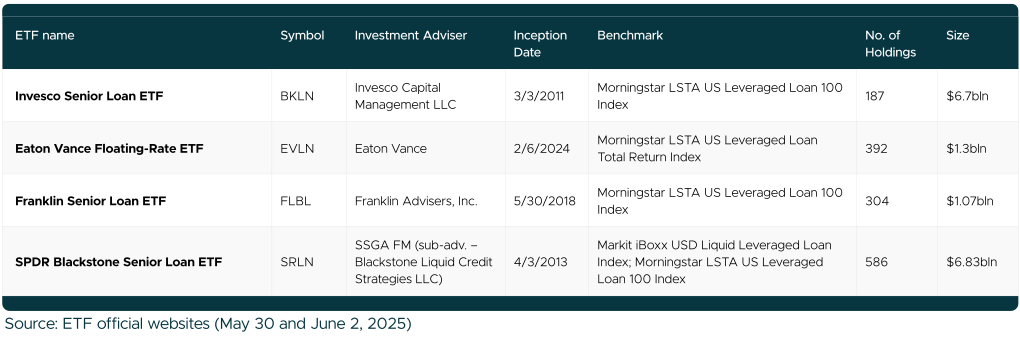
We selected a variety of CLO ETFs that invest in CLO tranches across the CLO capital structure, and with investments in CLOs across a range of vintage periods and asset managers.
Table 2: List of CLO ETFs
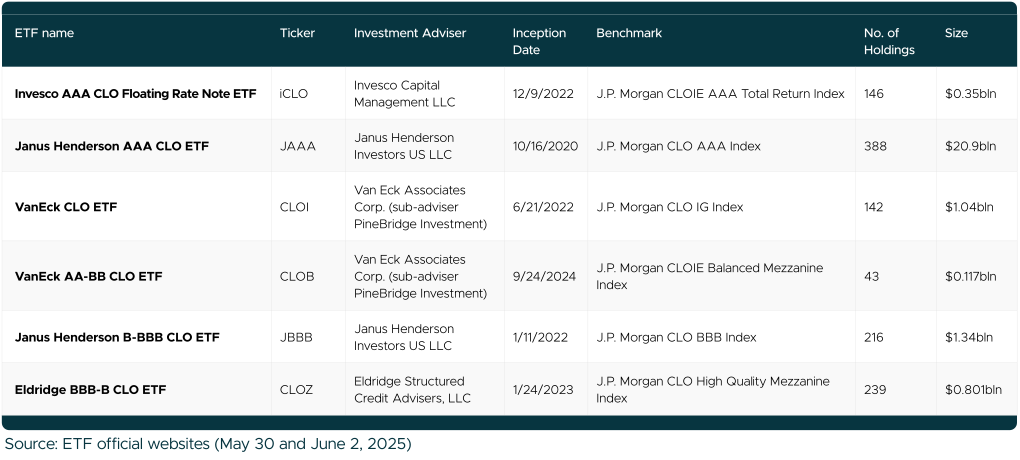
Understanding the underlying ratings distributions gives further insight into the level of exposures a CLO ETF has within a typical CLO capital structure. The CLO portfolios within our sample cover a range of credit risk exposures – from a fund with essentially 100% Aaa to other funds with a broader representation of investment-grade ratings as well as funds with concentrations of Baa/Ba credit risk[2].
We also included ETFs that can provide additional perspective on the relative performance of the BSL and CLO markets to the broader capital markets.
In this context, we selected a small cap equity ETF (IWM) since many BSL borrowers would fall in the small cap category; a high yield bond ETF (HYG) since these issuers have a similar credit risk profile (though with different recovery rate and interest rate risks) as compared to BSLs; and a short-term Treasury fund ETF (VGSH) to provide some benchmark of shorter-term risk-free interest rates.
We focused on the risk-return and correlation characteristics across the ETFs. We looked for insights into how the ETFs performance behaved with one another within the same category (‘intra-category’), and across categories (‘inter-category’) over different time periods. We observed that both intra-category and inter-category performance and correlation metrics depended heavily on which period we selected. We found that during the most recent market volatility (April 2025), patterns emerged that were not so evident during calmer periods.
In some cases, the correlations we observed between the BSL and CLO ETFs were not as consistent as expected. Understanding that CLOs are derivatives of the BSL market, we initially expected to see a relatively higher degree of correlation across all market environments, but the correlations across all market environments varied. This observation suggests that not all CLOs track the same broad ‘BSL market’.
We also found that CLO performance could be influenced by unique factors related to range of vintage periods of when the underlying CLOs were issued and the overall exposures to common CLO asset managers.
These findings show that these variations across CLO portfolios can offer an opportunity for CLO investors to diversify their BSL and BSL-derivative portfolios to better optimize their specific risk-return objectives. In other words, not all BSL and CLO ETFs are alike.
We chose two distinct historical return periods to begin our comparative analysis. One that we could classify as a ‘normal’ period and the other as a ‘volatile’ one. We chose the month of April 2025 as the volatile period. This period reflected significant market volatility due to the rapidly changing global trade outlook and economic uncertainties associated with the related US tariff announcements.
We selected the two-year period from April 2023 through March 2025 as a proxy of ‘normal market conditions’ and can be considered somewhat as a benchmark. Exhibits 1 and 2 show the historical return statistics and correlations of daily returns for each of the ETFs, respectively. Note that two of the ETFs in our sample were not in existence for the full two year-period analyzed. Thus, summary stats are not available, and correlation stats apply only for the respective period that each of these two ETFs was in existence.
We note that the return and risk characteristics across the ETFs are generally as expected within each investment category and subcategory. For example, among the BSL ETFs we note that there is no material distinction among the standard deviations and coefficients of variation. Among the CLO ETFs, the riskier CLO ETFs with lower rated tranches show higher volatility and coefficients of variation as compared to those CLO ETFs with higher rated tranches. The high yield bond ETF was the most volatile among the credit-sensitive ETFs. As expected, the small cap stock ETF was the most volatile while the short-term Treasury ETF was the least.
Exhibit 3 summarizes the cross-category correlations of historical daily returns. These are based on simple averages of correlations amongst the ETFs within their respective categories. The text box on the right provides guidelines for assessing the correlation results presented in this paper.
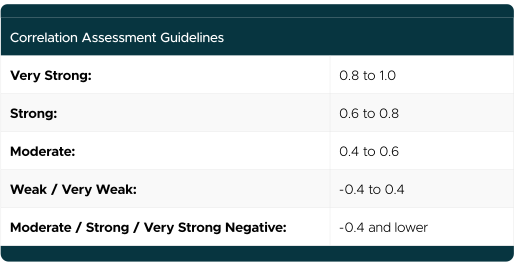
During ‘normal times’ NONE of the observed correlations were assessed to be Strong or Very Strong. All the correlations were assessed to be in the Moderate and Weak/Very Weak categories. Only 4 of the 22 observed correlations were assessed as Moderate while the remaining 18 were Weak / Very Weak. Three of the four that were Moderate, were related to the BSL category – BSLs to: BSLs, HY Bonds, and small cap stocks, respectively.
These observations suggest that during normal times, the correlations were not particularly significant for the CLO ETFs. Furthermore, CLO performance did not appear to be materially correlated to other credit risk assets, including the BSL market. Even within the CLO category, correlations were relatively marginal across the CLO capital structure, which suggests that movements in CLO tranche risk premiums seem to be more idiosyncratic during stable markets. These results are not surprising given that the CLO tranches are supported with credit enhancement – unlike CLO equity tranches, which we would expect to be more sensitive.
Exhibit 1: ETFs historical return statistics (April 2023 – March 2025)
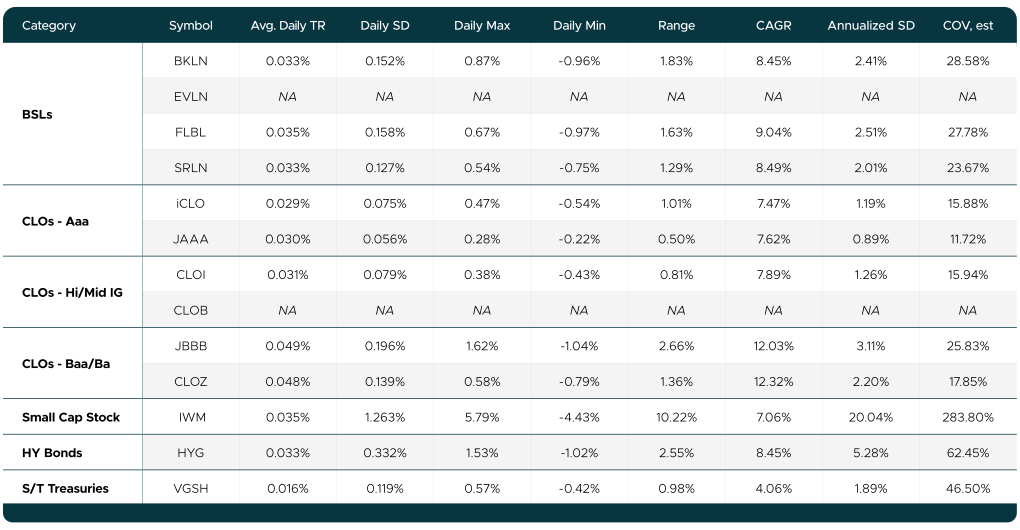
Exhibit 2: ETFs Historical Daily Return Correlation Matrix (April 2023 – March 2025)
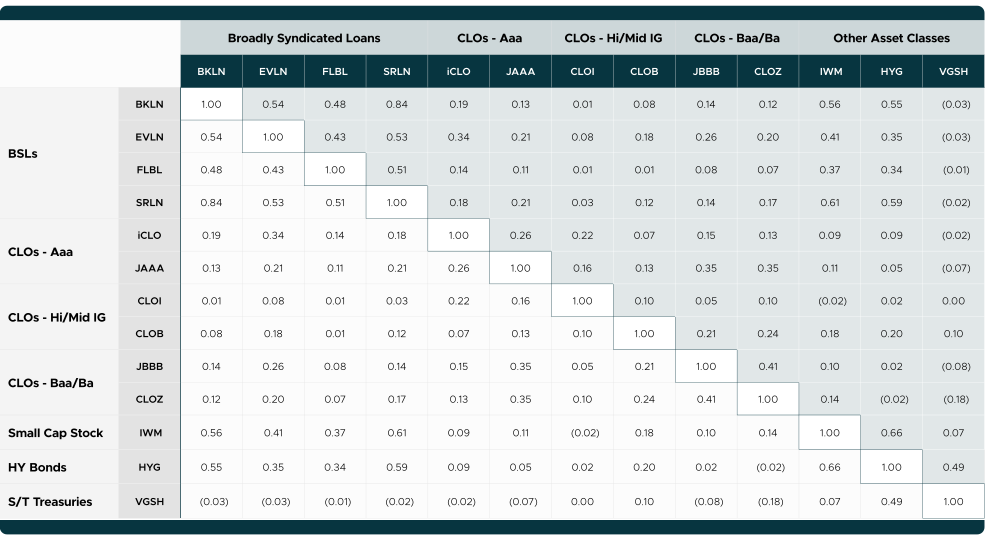
Exhibit 3: ETF Categories Historical Daily Return Correlation Matrix (April 2023 – March 2025)
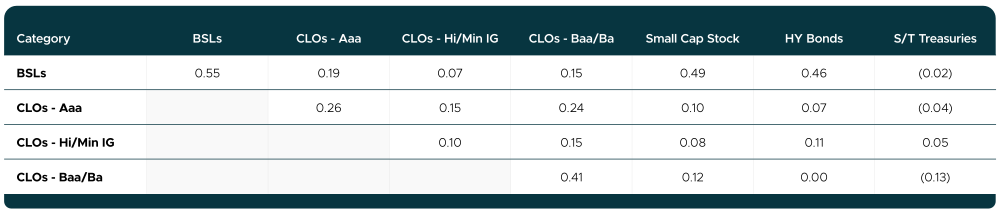
As previously explained, we defined the ‘volatile’ period to be the month of April 2025, a period of significant market volatility. Exhibits 4 through 6 show the various historical return statistics for the ETFs during this period.
One can immediately notice the significant jolt in the related risk statistics for all ETFs and the correlations among them. Below are some noteworthy observations based on the comparison of risk statistics between the two periods.
With respect to correlations, our observations show a sharp increase. Whereas during ‘normal’ times, correlations are not meaningfully significant, this changed during ‘stressed’ markets – half of the observed correlations are now assessed to be Strong and Very Strong (11 of the 22 observations) whereas 3 of the 22 are now Weak/Very Weak.
While correlations increased substantially, there were still some areas of divergence in performance that are worth noting. For example, the CLO ETFs such as the higher rated investment grade CLO ETFs show moderate correlations to all other asset classes. This implies that CLO ETFs may offer some diversification benefits (especially as you move up the capital structure associated with greater credit enhancement) even in stressed markets. However, the CLO ETFs with lower-rated tranches did show very strong correlations to the ’risk’ assets, but that is to be expected given their tranches’ higher degree of credit risk exposure associated with lower levels of credit enhancement.
Exhibit 4: ETFs historical return statistics (April 2025)
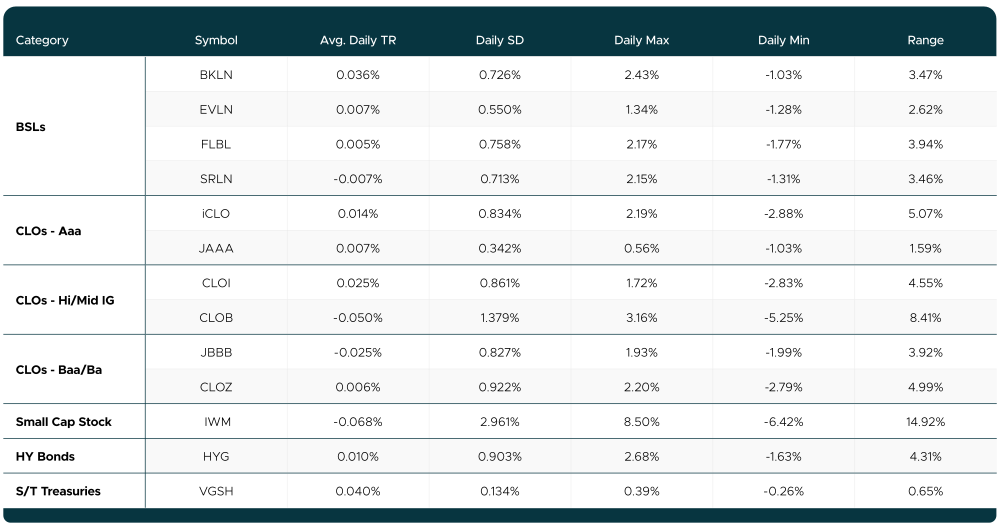
Exhibit 5: Historical Daily Return Correlation Matrix (April 2025)
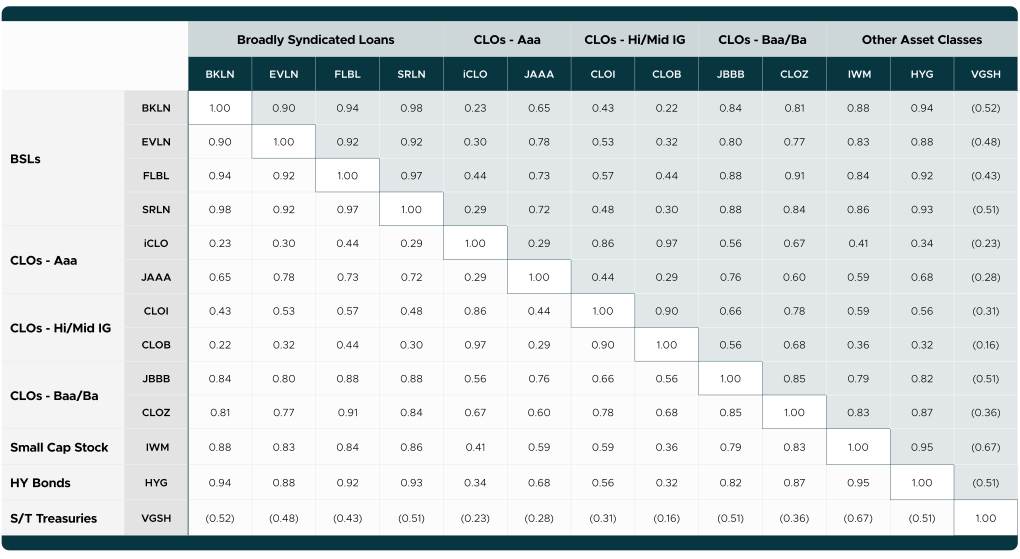
Exhibit 6: ETF Categories Historical Daily Return Correlation Matrix (April 2025)

A detailed attribution analysis of the underlying CLO ETF performances is outside the scope of this paper. However, we performed some high-level reviews of the CLO portfolios to look for potential factors that could affect the performance of the CLO ETFs and help explain some of the correlation behavior CLOs experienced, especially during the ‘volatile’ period as CLOs appeared to exhibit lower intra and inter correlations than the other asset classes.
Additional factors beyond market considerations appear to emerge when we look closer at the CLO portfolios. In addition to diverse capital structure exposures, we observed that the CLO ETFs had relatively diverse CLO vintage exposures. While exposures to common asset managers across the CLO ETFs could be significant, we noticed that the exposures were often across various CLO vintages of common managers.
Investing across CLOs with unique asset managers can provide diversification benefits despite targeting the BSL market. Different managers may have varying investment styles, strategies, size (or AUM), as well as industry/sector and credit expertise.
Notwithstanding the fact that a CLO portfolio may consist of several CLOs managed by the same entity, there can be advantages from diversifying across vintages. CLOs can be executed under different market conditions and potentially with variations in reinvestment criteria, even given identical CLO portfolio managers. Furthermore, CLOs from different vintages may be at various stages in their lifecycle, such as the reinvestment or amortization period, which also affects the level of a CLO’s reinvestment activity, as well as being past their non-call period, which can indicate the degree of potential refinancing activities.
ETFs composed of CLOs, with underlying BSLs, have experienced significant growth in recent years. While retail investors had access to funds of BSLs for over 30 years, the first publicly traded CLO ETF was introduced in 2020. This is noteworthy since a large part of the BSL market is held by CLOs and thus offers a broader group of investors to participate in the BSL-derived market across various risk/return profiles.
This paper analyzed the performance of CLO ETFs based on a sample of historical returns. The sample included different ETFs that target a range of CLO tranche seniorities, representing varying levels of credit risk. The performance of some BSL ETFs was also reviewed since the performance of a CLO tranche is essentially derived from its underlying BSL portfolio.
Our analysis of the historical daily returns and correlations of the ETFs show that over a longer ‘normal’ period, co-movements in performance are moderate and the risk/return characteristics across the ETFs are generally consistent with their underlying risk profile. However, CLO ETF returns and correlations can exhibit a noticeable divergence in performance and increase in volatility over a shorter period of extreme uncertainty. An example of which was during the recent period of market fluctuations caused by the US tariff announcements.
We also found that CLO correlations can be explained further by key factors such as the distribution of exposures to: (1) seniorities of the CLO tranches, (2) the vintage periods of when the CLOs were issued, and (3) asset manager overlap within a CLO ETF portfolio.
The bottom line is that CLO ETFs appear to offer investment diversification benefits and that not all CLO ETFs are the same, even given similar credit risk. While performance may appear to converge during stressful times, key differences in performance is also evident.
[1] Guggenheim Investments research dated December 7, 2023 – ‘Understanding Collateralized Loan Obligations’ (https://www.guggenheiminvestments.com/perspectives/portfolio-strategy/understanding-collateralized-loan-obligations-clo) and FT Opinion On Wall Street dated June 7, 2025 – ‘The trend strengthening the hand of big credit houses’ (https://www.ft.com/content/b5693e95-3a89-4df0-a1f8-ad3e70338458).
[2] Although some of the CLO ETFs may report CLO tranches that are “not-rated”, this is not technically correct in all cases since some ETFs generally report ratings only from the two largest and widely recognized NRSROs. Nonetheless, “non-rated” tranches may still be less liquid and more volatile given the absence of a rating from one of the two largest NRSROs, but likely to offer higher yields.
Conference
We are delighted to sponsor the ALTSHK forum this year in Hong Kong on June 13th. Join Jamie Loke at this investor-centered, education-focused forum from all sectors of the alternative investment sector.

Singapore
Head of Sales and Relationship Management, SEA


No related content found.
Conference
David Traverso and TJ Veneris are looking forward to networking and discussing what matters in private equity and venture capital at the PEI Private Funds CFO Network Chicago Roundup this June 6. Reach out via the contact below.

North America
Managing Director, Sales at Alter Domus North America

No related content found.